Monday, March 30, 2015

Secrets of a Manufactured Romance


Manufactured-Romance.png


In 1997 psychologist Arthur Aron and a team of colleagues published the results of a study designed to look at interpersonal closeness. In the experiment, the team was successful at making two strangers fall in love. How did he do it you ask? The experiment was quite straightforward. Two heterosexual participants (who were also strangers) entered a lab. One was male, one was female. They were required to sit across from one another and answer a series of 36 personal questions, which started out almost playful, eventually becoming quite penetrating, among them were questions like:

  • Do you have a secret hunch about how you will die?
  • What is the greatest accomplishment of your life?
  • How do you feel about your relationship with your mother?
  • Tell your partner something that you like about them already.
  • Of all the people in your family, whose death would you find most disturbing? Why?
  • What, if anything, is too serious to be joked about?
After responding to the series of questions, the participants were required to look silently into one another’s eyes for a period of four minutes. Throughout the experiment, gradually increasing levels of vulnerability created a bond between the participants at an accelerated rate. A kind of deliberate & expedited intimacy was achieved almost immediately as a result of this vulnerability. 

The surprising outcome of the experiment? The two participants fell in love and were married six months later. 

Biological components inclusive of such chemical powerhouses as hormones and pheromones are, of course, requisite elements in the process of falling in love. Nonetheless, the study demonstrates that it is possible to generate strong feelings between individuals, simply by making them communicate with one another on a deeply personal level. That is definitely nothing to scoff at! This study suggests that we can decide to care about others and consequently create the right conditions for trust, intimacy, and vulnerability, setting the stage for friendship and even love. 

The implications are powerful. 

At the mundane level, it’s easy to see that getting to know people around us can help create community and compassion fairly quickly and easily given a bit of effort.  However, if you are looking at the bigger picture, it seems that with very little in common and the right amount of attention and effort, humans are capable of caring for anyone. This optimistic research bodes well for the potential of creating a more peaceful and compassionate society.

If you want to try for yourself, check out the free mobile app, designed by the NY Times in consultation with Arthur Aron (lead author of the study). Visit nytimes.com/36q it will tak about 50 minuted to complete.

References
http://www.google.com/url?sa=t&rct=j&q=&esrc=s&frm=1&source=web&cd=2&ved=0CCUQFjAB&url=http%3A%2F%2Fwww.huffingtonpost.com%2Felaine-aron-phd%2F36-questions-for-intimacy_b_6472282.html&ei=AkQUVfS9IMO6mAX69YCADA&usg=AFQjCNHk2Eea9YE6LMWPY8YXpLKYRkAXlg&sig2=_jESLX5Na6BorcSDfQObww&bvm=bv.89217033,d.dGY

Friday, March 13, 2015

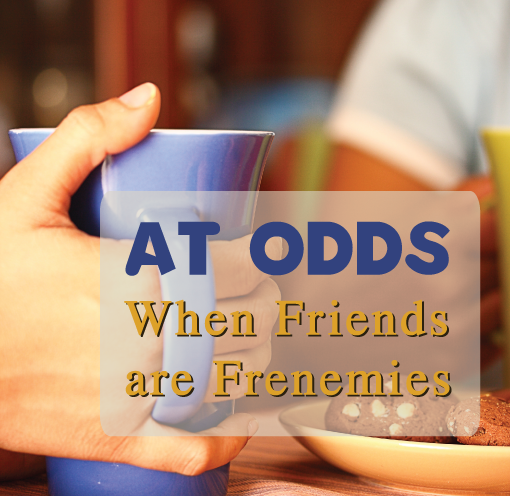
At Odds: When Friends are Frenemies

Frenemies.png

Friendships fall into various categories. Each with its own level of significance and impact on your overall level of social and emotional satisfaction. There are close friends and casual acquaintances. But there is another type of friend that you’ve probably encountered, the frenemy. First appearing in print in 1953, this term has become commonplace terminology in popular culture. The word frenemy is a combination of friend and enemy that points to relationships that are affable yet antagonistic. From the pervasiveness of this concept, it seems nearly everyone has had an encounter with one of these chums.

The relationships in your life are probably highly varied, ranging from those people you consider part of your inner circle to old friends who feel almost like family. There are also more casual friends and acquaintances in the periphery. Finally, you have a number of people you know socially, such as activity partners and colleagues. All of these associations bring some kind of value to your life. The frenemy may appear to add value, but in truth, the relationship is often hurtful and even damaging to self esteem. 

Identifying a frenemy

How do you know if you have a frenemy? You have likely had a subtle sense that things are not quite right with this person, no matter how much you like them and enjoy their company, there is a lingering sense that you can’t really trust them. Maybe you have heard that they spread gossip about you behind your back, or when you accomplish something, rather than being happy for you, they express envy. Perhaps it’s the backhanded compliments that come in place of genuine ones. Things like: “that haircut makes your face look so much less chubby!” or “wow, you actually look pretty with make-up on.” A compliment that smarts after it’s been given isn’t really a compliment at all and such statements can be indicative of a hostile friendship. It may be hard to identify your frenemy because there are times when they appear to be on your side, but then, you find that they’ve spoken poorly of you or flirted with your boyfriend. Frenemies are difficult for just this reason. There are qualities you like and enjoy, and others that make you feel awful. 

Another clue that your friend is a frenemy is a competitive attitude toward you or your accomplishments. If your friend is always comparing herself to you and competing with you, she’s could be a frenemy. Real friends tend to celebrate your accomplishments rather than behaving in a competitive manner. Frenemies are not genuinely happy for you and they let you know it. Continued encounters with frenemies can erode your confidence and self esteem. The feeling of competition can make you feel anxious and can even make hanging out with them stressful for you. Frenemies come in many shapes and sizes, chances are, if a friend frequently makes you feel bad using the subtle techniques mentioned above to undermine you, you’ve got a frenemy.

Strategies for dealing with a frenemy

Once you have identified that your friend isn’t really a friend, you will probably want to take some action. First, you may want to run your suspicions by someone you trust. This will help you put the situation into perspective.  Next, you’ll probably want to talk to your frenemy and tell them what you’ve observed. Let them know how gossip, competitiveness, and backhanded compliments make you feel. Your frenemy is probably not aware that these things have hurt you, so be calm and prepared for their surprise and even denial. After you talk, it will be easier to gauge whether the relationship is worth saving. If your frenemy seems genuinely surprised and willing to engage in a dialog about how certain behaviours have made you feel, you may want to continue to be friends. If she reacts with anger and hostility, chances are, she is not ready to acknowledge the unhealthy behaviour and you may need to make a break. Every situation is different. One thing you can count on is that you’ll feel better after sticking up for yourself and your feelings. 

Please feel free to reach out to me if you’d like help dealing with any of the relationships in your life.  I am available to new clients who are ready to overcome their challenges on a quest to transform their lives!  My website it full of blog entries and useful content to help you along your way, and I hope you find this free content useful on your journey. Feel free to reach out to me directly if have any questions or if you are interested in scheduling a private session.

Sincerely,
Dr. Eileen Wynne


References


Wednesday, March 4, 2015

Biology of Love: Brain Chemistry and Relationships

BiologyOfLove.png

Helen Fisher is a biological anthropologist who studies love, romance & personality and the chief scientific advisor at Match.com. She has written two books, books Anatomy of Love and Why We Love that look at the biology of who we choose to fall in love with. Recently, her Ted talk and NPR interview have given me some food for thought. I wanted to share some of what I have learned with you.

The biology of attraction & love

There are a number of social, economic, and psychological forces that work together to determine how we choose a mate, but what Fisher researches are the biological factors. In other words, she looks at temperament, traits which are heritable and linked to specific genes, hormones and/or neurotransmitter systems. Many people have wondered, over the centuries, what kind of magical force inspires human love. Biologically speaking, it simply comes down to chemicals. What goes on in the brain when we are in love? There are four primary chemicals that are released: serotonin, dopamine, estrogen, testosterone.  

Chemical personality types that determine romantic preference 

Using website, Chemistry.com (a division of Match.com), Fisher has developed a series of 56 questions called the Fisher Temperament Inventory designed  to collect data from a wide variety of respondents. Using the data collected from millions of individuals (thousands each month),  Fischer has been able to uncover 4 broad personality types based on dominance of these chemicals.  Although the actual chemicals are not measured, Fischer has built a series of questions designed to determine the levels of brain chemicals released in different people. After determining which type respondents are, she observes who individuals of each type choose to partner with. In her research, Fisher identifies 4 types of personality types based on typical neural systems.

Explorers. What Fisher refers to as a dopamine system. There individuals crave novelty and adventure. They are more susceptibility to boredom and tend toward impulsivity. Explorers have high energy and enthusiasm. Explores also tend to lack introspection.

Builders. This systems includes those with a serotonin system. Tendencies include sociability, lower anxiety, and more close friends. Builders tend to be cautious and observe social norms and rules, they also have respect for authority. They express self-control and conscientiousness.

Directors. These individuals have a testosterone system. They are  self confident and assertive. Directors pay acute attention to details and have deep, narrow interests. They also tend to be less socially aware, with poorer emotion recognition. Directors exhibit little eye contact and are less verbally fluent, and they also show less empathy. 

Negotiators. These individuals have an estrogen based system. They tend toward cooperation and holistic and long-term thinking. Negotiators are intuitive, empathetic and agreeable. Generosity and trust are also traits associated with these individuals. 

What is your type? Find out  here.
Want to take one of her love quizzes? Click here.

After identifying the types, Fisher further noted how types choose romantic partners. Basically, what she discovered can be broken down in a few sentences. Explorers like other explorers. Builders like other builders. Directors and Negotiators tend to like their opposites. Less magical, perhaps, than one might hope, but incredibly fascinating information. A final noteworthy bit of Helen Fisher’s research demonstrates that when you suffer heartbreak, the chemicals in your brain actually match the intensity of the chemicals you express when you are in love. The motivation and craving for the object of affection actually grow more active and the intensity greater when you are unable to get what you want. Fisher is likely to continue this research, and there are many other open questions to be answered. For now, the realization that there is a strong chemical component to love might make navigating the murky waters of romance a little clearer. 

If this post interested you, listen to Helen Fisher’s Ted Radio Hour episode: What Happens To Our Brain When We're In Love?

Please feel free to reach out to me if you’d like to further discuss the relationships in your life. I am available to young professionals and emerging adults who are ready to overcome their challenges on a quest to transform their lives!  My website it full of blog entries and useful content to help you along your way, and I hope you find this free content useful on your journey. Feel free to reach out to me directly if have any questions or if you are interested in scheduling a private session.

Sincerely,
Dr. Eileen Wynne

References
https://www.youtube.com/watch?v=OYfoGTIG7pY
http://www.helenfisher.com/downloads/articles/Article_%20We%20Have%20Chemistry.pdf