Tuesday, May 26, 2015

Wallflower Power: Why Understanding Introversion is Important


Wallflower-Power.png

A Quarter of the Population is Misunderstood

As noted in my previous article on the subject: “Introverts tend to be reserved and solitary, while extroverts are typically characterized as outgoing and social.” We have already discussed the fact that about 25% of the population is thought to be introverted. The primary differences between introverts and extroverts are neurological and biological. Introvert brains processes information differently, using many parts of the brain when making decisions and coming to conclusions, and therefore, they have slower processing speeds. The other key difference between introverts and extroverts is the way they feel about social situations. Extroverts tend to feel alive and energized in groups and social settings, while introverts can quickly become exhausted when they are required to interact with a group. Introverts need lots of quiet, alone time to replenish themselves. 

Since extroverts make up the majority of the population, it has become the ideal by default. Introversion is just beginning to be understood, and therefore, we have a misunderstood minority that has been forced to try to live in a world made by and for an extroverted majority. This means that many people who are introverted have been required to behave as if they are extroverts or feel as if there is something wrong with them. This doesn’t benefit anyone because society as a whole loses the valuable input of a sizeable segment when it ignores  introverts. 

The Value of Introverts

When Susan Cain wrote her New York Times bestseller Quiet: The Power of Introverts in a World That Can’t Stop Talking, she got people around the world thinking about introverts and how recognizing and respecting the unique characteristics of introverted people is enormously important. The subsequent TedTalk empowered introverts around the world to start thinking about their own value and how many of the spaces and activities in our culture are designed by and for extroverts. In particular, Cain addressed the way that collaboration and group work has taken the place of independent study and work in many university classes and corporate office environments, and how that may be highly detrimental to innovation, as the most dominant voice in a group is likely to influence the others on a team. Extroverts like to talk through ideas in meetings, whereas introverts need quiet space to think through an idea. This means that introvert voices and opinions can be completely drowned out and lost in group situations. 

Why does this matter? 

Besides the fact that about a quarter of the team goes unheard, introverts are deep thinkers and tend to process matters more thoroughly, so losing their input means losing very thoughtfully considered opinions. The different brain wiring of introverts also makes writing a very valuable means of communication for them. Writing uses different pathways in the brain that speaking does and this form of communication comes naturally to folks who are introverted, allowing for high levels of fluency. Meetings and group projects don’t offer the same space for writing as independent work does, therefore eliminating the ability for introverted individuals to work through problems and in turn, losing their valuable input. Recognizing the introverts in your work and school environment, will allow you to capitalize on their deep thinking and maximize the value of your teams. 

We live in a world that is rich with diversity of all kinds, the more we recognize all the different approaches to thinking and being that exist, the more amazing our world will be. 

Wondering if you may be an introvert? Take Susan Cain’s informal quiz to find out.

Sincerely, 
Dr. Eileen Wynne


References


Monday, May 18, 2015

Going Places: Finding Your Life's Work


Going-places.png


Whether you are 23 or 43, figuring out what you want to do with your life can present a serious challenge. According to Abraham Maslow’s oft cited Hierarchy of Needs, self actualization rests at the top of the five stage pyramid and is the last of the humans needs to be achieved as one moves through life. It makes sense that more basic needs like psychological and safety requirements must be met before higher level needs like esteem and self actualization can be accomplished. Typically, a satisfying career fits into the higher stages of a system like this. It is not essential to survival, but it is key to high functioning and emotional growth that one finds work that is challenging and fulfilling.

Discovering Aptitude
There are myriad personality and career aptitude tests designed to help you figure out your ideal career. These tests can help you assess where your interests, values, strengths, and preferences converge. Some of the most common are:
  • Myers-Briggs Type Indicator (MBTI)
  • Strong Interest Inventory (SII)
  • Self-Directed Search (SDI)
  • Career Ability Placement Survey (CAPS)

These will profile you make suggestions that may help you find a suitable path.

Figuring out what you are meant to do
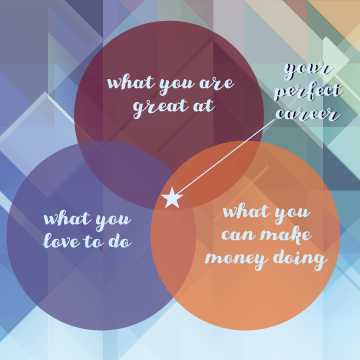
After analyzing your aptitudes, you will be left with your intuition and inclination. What you are really meant to do may take some time and work to uncover. Finding your path is a process that takes many factors into consideration. The intersection between what you are great at, what you love to do, and what you can make money doing may help you realize what you are truly meant to do.
Venn.png

There are numerous books and workbooks on this subject, but, a few simple questions that may point you in the right direction and help you figure out what your life’s work should be are:

What have you always loved to do?
What have you loved doing since you were a kid? What hobby do you do that is so wonderful that you lose time entirely while participating in it? This activity may be a hint at what you are meant to do in life. Think about careers that incorporate your beloved activity in some way.

What are you attracted to?
What is your favorite movie? What music do you love? What are your favorite museums? What countries fascinate you? Your cultural interests may help you find your perfect career path.

What are you really great at?
Sometimes the thing that comes most naturally to you is what you are meant to do. Be it bicycling or painting watercolors, the things that you naturally excel at may hint at what you are meant to do with your life.

When you follow the things that inspire and excite you, you will be well on your way to finding a fulfilling career. When you find the job you were meant to have, you will still have to work hard, but it will not feel like work because you’ll derive incomparable satisfaction from it. Whatever your path, remember that everyone has a very unique part to play. There is something that you are here to do that no one else can do quite as well as you can. When you find that thing, you’ll feel harmonious and expansive and your life will open up with great opportunities.


References

Monday, May 11, 2015

Let it Go! Knowing When to End a Relationship

Let-it-Go.png


As you move through your lives, you will inevitably grow and change. Often, as you make big, positive changes,  you begin to see that some of the ways that you have been doing things have not been serving you very well. When this type of shift occurs, you will find that some of the people in your world no longer share the same values as you do or support you in ways that are meaningful. Sometimes you just know that you need to break free from a relationship, be it a friendship or a romantic partnership, but feel reluctant to hurt the other person. This is a challenging situation for anyone, and one that deserves deep consideration. 

Should I stay or should I go?
When you reach the make-or-break point, it’s important to do a thorough analysis of the relationship to see if it is one that can be salvaged or one that you should sever yourself from.


Below are five signs that a relationship may be ready for release:


  1. When little things start to cause you to feel irritation and even resentment towards a person, it is a sign that the warmth and goodwill in your relationship may have run its course. You used to be mildly annoyed when your friend seemed competitive, now it makes you feel irate. An old friend seems to make all the wrong choices all the time and you cannot bear to watch the disasters unfold any longer.  Your sweetheart always forgets to bring his wallet when you go out or does the same old things that irritate you in spite of numerous reminders. When things that were once minor annoyances start to drive you mad, you may be heading for a split.
  2. When all of your effort to make needed change fails to bring the change about. You’ve talked until you’re blue in the face, you’ve gone to counseling, you’ve tried to make new rules and stop doing the things that annoy one another, but all the effort seems to fall flat. When you try everything to make a relationship better and it still seems to be falling apart, or if you cannot break negative patterns and change the relationship in spite of your best effort, it may be a sign that you’d be better off without it.
  3. If your relationship is keeping you from growth and expansion, it is probably time to let it go. There is always compromise in relationships, which is healthy and promotes the higher good of both parties, but there are also situations where one person holds another back. Regardless of whether they mean to or not, if your loved ones are keeping you from achieving your highest good and expressing all the great things you have to express in your life, you are not doing yourself (or them) any favors by sticking around. MOVE ON!
    *Additionally, if you are continuously making sacrifices for the sake of the other person, perhaps it’s time to find yourself a more equitable relationship.
  4. When you stop answering the person’s calls or groan when you see their name in your inbox, it might be time to cut ties. Sometimes a relationship starts to feel heavy. When the thought of a person makes you feel tired and spending time with them puts you in a state of exhaustion, you have a problem. In addition, if you are continually engaging in power struggles that leave you feeling tired and you feel more alive and inspired when you think of your life without a person in it, it’s probably time for a change.
  5. When you’ve had to change yourself in ways that are not positive or beneficial to be in the relationship it is a clear indication that the relationship is not healthy for you. If the relationship requires that you stay at a superficial level or if your values don’t align, you should not have to try to contort yourself to be in a relationship. This one is very important, probably the most critical. If a relationship inspires you to change in ways that are beneficial, it is likely a positive one, however, if you have to hide things about yourself or behave in a manner that is not true on a consistent basis, the relationship is probably not serving you. If you have different values and can share them in an atmosphere of mutual respect, that’s fantastic, but if you are consistently being required to hide or change yourself or if you cannot express yourself, it’s time to move on.


Saying adios
When letting go of a relationship, it can be helpful to remember that sometimes you have to remove old relationships to make room for new ones. Lots of the things in our lives have expirations dates. Often, we find that we have learned and expanded as much as we can at a job and have to find a new one so that we can continue to have challenge and growth in our careers. In other circumstances, we find that the place we are living becomes too small or too inconvenient for our current needs. Letting go is a fundamental life skill that must be mastered as we move through our years. Letting go often signals progress and expansion, it is something to celebrate and embrace!

Thanks for reading this post. My website it full of blog entries and useful information to help you along your way, and I hope you find this free content useful on your journey. Feel free to reach out to me directly if have any questions or if you are interested in scheduling a private session.


Sincerely,
Dr. Eileen Wynne

References
Sunday, May 3, 2015

Fighting for the Future: Students in Virginia Help Make Mental Health Resources Available to Everyone

Fighting-for-the-Future.png


As I noted in my previous blog on this subject, over the last decade, there has been a dramatic rise in mental health issues for students nationwide.  With a quarter of 18-24 year olds estimated to have diagnosable mental illnesses, we really do appear to be having a mental health crisis. An increasing number of colleges and universities are taking positive and responsible action to ensure the safety and well-being of students by setting up mental health centers and providing students with information about additional mental health resources. Still, the relatively limited reach of a university mental health center may not be enough for some students, particularly if they don’t even know the center exists. 

Coping with mental health problems can be extra challenging for emerging adults. Furthermore, dealing with things like anxiety and depression can be downright debilitating without the proper resources. To date, even at colleges and universities where there is a dedicated staff of counselors and psychologists available to offer services through student health centers, the  lingering stigma attached to mental health and the fact that students remain unaware that these resources exist, prevent many students from getting the help they need.

With all of this seemingly negative news on the subject, it is refreshing and inspiring to know that a group of students at UVa (University of Virginia), called the Young Legislators of Tomorrow, brought this issue to the attention of lawmakers in their state. The group introduced a Bill (House BIll 206) requiring universities to provide more and better information about mental health resources to students. 

In 2014, this legislation passed in the House 99-0, making it a huge win for those determined young people trying to raise awareness and make the world a better place for the students coming after them. It is also a victory for all the future students who will be better able to find the help they need as a result. 

According to Virginia’s Legislative Information System, the summary of the bill is as follows: Four-year public institutions of higher education; mental health resources. Requires each four-year public institution of higher education in the Commonwealth to create and feature on its website a page with information dedicated solely to the mental health resources available to students at the institution. (The bill has a delayed effective date of July 1, 2015.)

The combination of the stigma attached to mental health problems and students’ lack of familiarity with the resources available to them has allowed many to suffer needlessly. Thanks to this group of students, the awareness part of that problem is going to be significantly minimized in the future.


Sincerely,
Dr. Eileen Wynne


References: