Showing posts with label career. Show all posts

Monday, September 12, 2016

Soft Skills: Emotional intelligence and success


What is Emotional Intelligence?

In 1990, scientists John D. Mayer and Peter Salovey came up with the concept of emotional intelligence. The term described a form of social intelligence that included the ability to:
  • Monitor one's emotions and those of others,
  • discriminate between these emotions and feelings, and, 
  • to use this understanding to guide one's behavior. 
Simply put, emotional intelligence is a person's ability to identify, understand, and monitor their emotions and those of the people around them. Emotional intelligence differs from cognitive intelligence, which is more intellectual and includes understanding information and solving problems. Emotional intelligence is interpersonal; it plays a big role in the development of one's people skills. 

Why is it important?

Emotional intelligence can be a critical determining factor in social functioning. In some ways, it is much more important than cognitive intelligence to overall success.  Understanding other people and how they feel can give you a strong advantage both professionally and personally. It is much easier to communicate to a person in a way that they understand, to motivate people, and to stimulate teamwork if you know where people are coming from.  There are some different ways that emotional intelligence is expressed. Below are a few excellent examples of emotional intelligence in action.  

Empathy
Sometimes called the cornerstone of emotional intelligence, empathy, and emotional intelligence go hand in hand. Empathy is a key behavior demonstrating emotional intelligence. Empathy can be understood as the ability to put yourself in someone else's shoes and understand how it feels to experience the world from their point of view. It leads to better communication because when you understand how someone else feels, you can better explain things to them in a way that is meaningful and memorable. This understanding of others, in turn, increases trustworthiness.

Self-Awareness
As one moves into adult life, self-awareness becomes critical for high-level functioning. Self-awareness includes having a true understanding of one's emotional motivations, desires, and goals. Another part of Self-awareness is awareness of your strengths and weaknesses; this enables you to make academic and career choices that will benefit you by enabling you to build up skills you lack and fully develop those that come more easily to you. Self-awareness also includes your self-esteem and confidence. It is important to know where you feel confident and where your self-esteem could use a boost.  Self-Awareness ultimately leads to self-management, emotional regulation, and an appropriate overall understanding of the self about the greater world. 

Effective Teamwork 
Emotional intelligence is key to success in the workplace. Nearly all top performers have mastered emotional intelligence. This means that they understand their motivations, strengths, and goals AND that they also understand what motivates others. When team members feel understood and respected,  there will naturally be trust, and that leads to much more effective collaboration and teamwork. This aspect of emotional intelligence is important as we move through our careers. Understanding people and recognizing the subtle clues that emotional intelligence illuminates can make all the difference in the opportunities one os given. Additionally, if there are interpersonal challenges in the workplace, the empathy, and self-awareness that come as a result of emotional intelligence lead to more effective conflict management.


Developing emotional intelligence
As is evidenced above, emotional intelligence is an asset as one moves into more social, team, and career situations. Having a better understanding of other people can be useful throughout one's academic life and as one moves onto their career path. So how can you increase your emotional intelligence skills?

  • One of the easiest ways to increase emotional intelligence is to be begin noticing nonverbal communication. Observe the people around you and start to note whether you can tell what their mood is based on how they stand or walk, their facial expressions, and their gestures. You will be amazed by how much you can tell just by watching people.
  • Another way to improve your emotional intelligence is to pay attention to your responses to various situations. Rather than reacting, try to experience the feelings and emotions you have about certain events and then choose a proactive approach to dealing with situations that bring up strong emotions. Learning to observe your patterns in a non-reactive manner can help you become more self-aware and improve your self-management.
  • A great way to boost your emotional intelligence is to learn techniques for managing your stress. When you are in control of your emotions, you are better equipped to pay attention to all the subtle social cues in your environment. You can also help the people around you manage their stress better when you approach things with a cool head. This can be challenging at first, but after you find some strategies that help you manage stress, you will be able to deal with well with any pressures that come along.
  • Be honest and kind. A very powerful way to increase your trustworthiness is to be honest in a kind and constructive way. This does not mean to say whatever is on your mind; empathy will enable you to gauge how you can communicate in a manner that is forthright and also helpful. Learning to say things that are difficult is one of the fastest ways to gain trust and respect. It can be hard at first, but by practicing you can make this part of your approach to dealing with others. 

Formerly on staff at the Tulane Student & Health Center of Psychiatry, helping emerging adults uncover the best path to success is my passion. I am a professional psychotherapist and I specialize in academic, success, and life coaching. I work primarily with college students and young professionals. I would love to put my expertise as a certified success coach to work for you.  


Sincerely, 
Dr. Eileen Wynne

Friday, July 15, 2016

Finding your brightest future!


Recently a friend asked me what it actually meant be a certified success coach. I figured that if one person was wondering, there were probably several others who also wanted to know. To that end, this month I am dedicating my post to explaining what a certified life and success coach does, and why working with one can be beneficial. 

First of all, though I am a therapist, coaching is not the same thing as therapy. Coaching helps you improve your life, by helping you identify what you want and come up with a plan for getting it.  

You are the expert on your life, but sometimes, having someone who is invested in seeing that you meet your fullest potential can be invaluable. Friends and family are absolutely invested in your life, but have their own agendas, and cannot always support you when and where you need a boost. Partners cannot always see your needs apart from their own. In short, everyone in your life is trying to figure out the same things that you are trying to figure out, and while talking with your partner, family, and friends is important, they cannot always give you the clarity and focus that an unbiased, dedicated coach can give.  When you engage a life coach, you are embarking on a one-on-one relationship with someone who can help you navigate your life for maximum success. A success coach is an advisor, a cheerleader, and at times, a guide, not unlike an athletic coach. Having this type of dedicated resource can help you untangle the most confusing matters and put the most daunting plans into action by providing you with the motivation and accountability necessary to move forward in the toughest of situations. 

You know where you want to go and the job of a success coach is to help develop a roadmap for meeting your targets, keeping you on track along the way so that you can reach your destination and set a course for the next phase of the journey.  Throughout your journey, challenges my come up: losses,  interpersonal conflicts, relationship concerns, and issues of identity and self-esteem. A coach can help you navigate these scenarios and learn the lessons that they have to offer you.  In typical coaching sessions, we discuss goals and aspirations and then develop practical, strategic plans for the achievement of those goals. We also work through the issues that arise so that feelings of self-confidence and self-efficacy are maximized.  

Each challenge is an opportunity to gain greater mastery!
Goal setting is one of the fastest ways to unlock confidence and realize self-efficacy.  What is self-efficacy? In a nutshell, it is the feeling that you can accomplish the goals you set out to achieve, it is the confidence that comes from the experience of achievement.  It is natural to fear some challenges, but healthy self-esteem and a sense of self-efficacy work together to enable you to overcome fears and make important strides toward a fulfilling future. Setting goals and then attaining them gradually builds up your belief that you can do the things you set your mind to. 

Defining success
Not everyone has the same definition of success. Let’s face it, we are all very different and have unique desires, values, and capabilities. Part of being successful is knowing what matters to you, as well as what does not. One of the biggest psychological problems that has developed with the rise of social media has been the accompanying social comparisons that degrade people’s self-esteem. Looking at someone else’s life can be a fun pastime, but comparing yourself to another can be stressful and can seriously damage self-esteem. One way to combat this tendency  and to set yourself on a path to your own success  is to develop a true vision for what success means  to you. A success coach can help you get to the heart of what your own success looks and feels like, making it much easier to identify the opportunities that will help you realize a truly happy life.  Your ideal life is just that, yours. Working with a dedicated coach can help you identify what matters most to you and avoid people and positions that are not aligned with your desires and values. 

Finding your life’s purpose
As you move through your education and career, there will be lots of opportunities to develop new skills and take professional and personal risks. A coach can help you choose the options that are most appropriate for you. As academic and professional careers advance, there will be failures and successes. A coach can help you look more objectively at life's events and see where you can do better and where important lessons have been given. Making mistakes can be painful, but failures also hold the seeds of wisdom. When you fail, you often get closer to success. The key is to step back and see what you can learn from mistakes.  Your coach can help you grow in your career and in your life. 

To me, therapy is kind of like a jigsaw puzzle, gradually, pieces come  together and there are a-ha moments along the way as my clients learn about themselves. I love being able to help facilitate that awareness. 

Are you a university student or young professional struggling to find the right direction? Are you looking for career support?

I work primarily with college students and young professionals and would love to put my expertise as a certified success coach to work for you.  Helping emerging adults uncover the best path to success is my passion. I am also available for insight-oriented, supportive therapy. 

Sincerely, 
Dr. Eileen Wynne

Monday, June 20, 2016

Making Their Way: Unique challenges of being a Millennial


When you see the numbers, you may wonder what is happening with Generation Y.

•    Millennials make up about a quarter of the U.S. population
•    37% of millennials are unemployed
•    Approximately 1/3 of millennials still live with parents
•    In 2013, only 30 % of young people (ages 20-34) were married, (compared to 77%  in 1960)

Accusations of perpetual childhood and Peter Pan syndrome in millennial culture abound, but are choices like is staying at home with parents and not getting married really choices, or has culture shifted so much that young people don’t know how to navigate it and make their way into adulthood? Author Jeffrey Arnett describes the extended adolescence of what he calls “emerging adults” and suggests that young folks today may have more time and space to develop into good humans with strong foundations as a result of this extension of childhood. Additionally, many suggest that time for exploration before settling down and getting married may lead to more stable relationships, not less. These optimistic takes are far fewer than the criticisms of Gen Y. Many recent articles on the subject complain about inflated self-opinions which are the natural result of a culture of political correctness where everyone wins, with or without merit;  and the whole generation’s constant desire for praise and reward without commensurate skill. They also note the self-obsession that is the natural result of social media and reality TV culture. The one thing no one argues about is the fact that millennials are definitely behaving differently than previous generations.

What a difference
A recent study conducted by the Pew Research Center looked at millennial behavior and demonstrated that for the first time in over a century, young people (ages 18-34) are living with parents more frequently than in any other type of living arrangement.  With a third (32.1%) of young folks remaining in their parents’ homes, rather than living alone, with a romantic partner, with a friend or non-parent family member, or in a college dorm; it is natural to wonder what has led to the shift. Some researchers attribute these new trends to the fact that fewer young people are settling down romantically. It is noted that young men are more likely than young women to be living in the home of a family member while women are more likely to be the head of a household because they tend more frequently to be single parents.

The study suggested that a few different factors contributed to the change, namely (and not surprisingly); marital status, education, and employment. Researchers  place most weight on the fact that many young people in the U.S. are making the choice not to settle down with a romantic partner and this postponement, and sometimes complete retreat from marriage, removes some of the impetus to leave the nest. In fact, in the last decade, the median age for first marriage has steadily increased, with one in four never marrying at all, leaving many wondering if there is something wrong with the entire generation. We fail to ask, time and time again, why don’t these young people want to settle down? What is the root cause of the decline in independent living and failure to marry?

Products of a rotten economy?
Fox News’ Dr. Keith Ablow is quick to attributes these trends to a weak economy and overall lack of employment opportunities for millennials. He also makes  some rather harsh criticisms. It is an absolute fact that employment trends have contributed to the changes in millennial lifestyles and to blame it completely on marriage is to miss a big piece of the puzzle. The Great Recession stopped many young people in their tracks, making things harder than they have been for previous generations and instilling many with the fear that there was no place in the working world for them. While some have been discouraged to the point of depression, this has served to make many young people resourceful and nimble.  Ablow describes dispirited youth with squandered potential,  depressed, anxious, and high on legal drugs, seeking desperately to get free from the tyranny of continually coddling parents. He goes on tirades about Tinder culture, and young folks hooking up rather than having meaningful, long-term relationships. Fortunately, the reality is a more complicated and interesting than that. Millennials are making different choices, but they are, in fact, making choices.

Setbacks lead to a new worldview
The findings of the Pew study may seem discouraging to many older Americans who can’t understand why so many young folks are falling behind.  The conversation typically circles around to larger cultural criticisms; talk of an entire generation ruined by too many frivolous participation awards and pointless kindergarten graduation ceremonies, and genuine achievement being watered down by a culture by handing out a steady stream of awards and accolades for next-to-nothing. There are also the inevitable complaints about laziness, video games, and substance use.  Still, it’s important to note that this generation has also faced instability and change, significantly different from that of previous generations. As with nearly every issue facing us today, there are multiple contributing factors – the Great Recession being a big one and the cultural shift that taught young people that every tiny achievement was worthy of accolades is another.  At the core of the litany of complaints from other generations is that this group can’t seem to let go of childhood. Maybe that is true. But in some ways, not jumping into things one isn’t ready for may be a maturity older generations never go the luxury of exploring. The truth is that there is no conclusion to this conversation. This generation of emerging adults if figuring it out as they go, just like every other generation before has had to do.

From a paper about Millennials published for the White House by the Council of Economic Advisors in October 2014

“…while there are substantial challenges to meet, no generation has been better equipped to overcome them than Millennials. They are skilled with technology, determined, diverse, and more educated than any previous generation. Millennials are still in the early stages of joining and participating in the labor market. Taking steps to help them access and complete college, manage their student debt, have better opportunities for training and connection to jobs, access the credit they need for a home, protect the network neutrality that is the basis for much of their technological activity, as well as general policies to strengthen investment, job creation and wage growth, all have the potential to have a lasting impact for this generation and thus for U.S. economic performance for decades to come.”

Please feel free to reach out to me if you’d like to further discuss the unique challenges facing Millennials. I am a Psychotherapist available to young professionals and emerging adults who are ready to overcome their challenges and transform their lives!  My website it full of blog entries and useful content to help you along your way, and I hope you find this free content useful on your journey. Feel free to reach out to me directly if have any questions or if you are interested in scheduling a private session.

Sincerely, 
Dr. Eileen Wynne


References

Monday, June 8, 2015

Sail Away! How Vacations Keep You Healthy & Happy

Sail-Away.png

In the U.S. we are given far less vacation time than in most other countries. It seems we don’t fully understand the importance of taking time to rest and renew ourselves. About 40% of Americans fail to use the vacation time allotted them. In fact, a 2014 study demonstrated that in the U.S., on average, employees only take about half of the vacation time they are given and many of the people who do take vacation, work while away. This is likely true because, in spite of the fact that employees who take vacation time are more productive, have better morale, and have higher rates of retention, a study conducted by Forbes found that 17% of managers felt that employees who took vacation were less dedicated than those who did not. 

According to an article in USA Today, “The United States is the only developed country in the world without a single legally required paid vacation day or holiday. By law, every country in the European Union has at least four work weeks of paid vacation.” This wikipedia chart shows the minimum mandatory vacation days, by country, worldwide. The United States is the only country with 0 days listed. 

What are we missing?

Taking Time Off
The health benefits of time off have been demonstrated in a number of recent studies from the likes of prominent voices in the business world, such as Ernst & Young and Forbes to health authorities like Healthnet and WebMD. From dramatically cutting instances of heart attack and heart disease to healthier waistlines, the physical benefits are substantial. On top of the physical benefits, there are psychological, mental health, and wellness benefits to taking a break from routine. Some of these include:

  • Less stress and a more positive outlook on life. Getting away on vacation can help alleviate the stress of your work life. By simply removing yourself from the stress inducing environment, you reset yourself. People also report feeling more satisfied with their lives during and after a vacation.
  • Greater motivation to achieve goals and improved productivity at work. Several recent studies demonstrated that time off increases performance and productivity of employees.
  • Decreased depression. Studies show that those who take regular, annual vacations suffer less stress and fewer instances of depression. It could be that those who take regular vacations, also have a greater commitment to self care, as these individuals also tend to have positive emotional outlooks.
  • Sense of closeness to spouse and family. After a vacation, many folks report feeling more connected to family members. Additionally, spouses feel closer after a trip together, as less stress facilitates more love making and better communication.
  • Growth and flexibility for young travelers. Young people who travel report feeling more independent, more trusting, and more confident after vacation. These travelers also express the desire to travel more and have new experiences. 

The bottom line: work-life balance is extremely beneficial. So, plan that vacation. Don’t let fear of making a negative impression on a manger keep you from enjoying the myriad physical and emotional benefits of resetting yourself. Your improved morale and productivity upon return will speak for themselves!

Sincerely,
Dr. Eileen Wynne


References:


Monday, May 18, 2015

Going Places: Finding Your Life's Work


Going-places.png


Whether you are 23 or 43, figuring out what you want to do with your life can present a serious challenge. According to Abraham Maslow’s oft cited Hierarchy of Needs, self actualization rests at the top of the five stage pyramid and is the last of the humans needs to be achieved as one moves through life. It makes sense that more basic needs like psychological and safety requirements must be met before higher level needs like esteem and self actualization can be accomplished. Typically, a satisfying career fits into the higher stages of a system like this. It is not essential to survival, but it is key to high functioning and emotional growth that one finds work that is challenging and fulfilling.

Discovering Aptitude
There are myriad personality and career aptitude tests designed to help you figure out your ideal career. These tests can help you assess where your interests, values, strengths, and preferences converge. Some of the most common are:
  • Myers-Briggs Type Indicator (MBTI)
  • Strong Interest Inventory (SII)
  • Self-Directed Search (SDI)
  • Career Ability Placement Survey (CAPS)

These will profile you make suggestions that may help you find a suitable path.

Figuring out what you are meant to do
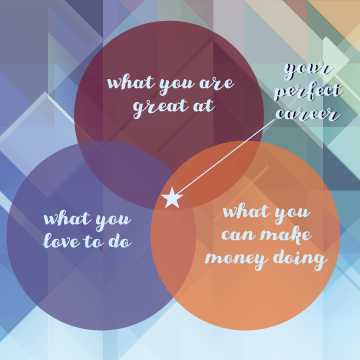
After analyzing your aptitudes, you will be left with your intuition and inclination. What you are really meant to do may take some time and work to uncover. Finding your path is a process that takes many factors into consideration. The intersection between what you are great at, what you love to do, and what you can make money doing may help you realize what you are truly meant to do.
Venn.png

There are numerous books and workbooks on this subject, but, a few simple questions that may point you in the right direction and help you figure out what your life’s work should be are:

What have you always loved to do?
What have you loved doing since you were a kid? What hobby do you do that is so wonderful that you lose time entirely while participating in it? This activity may be a hint at what you are meant to do in life. Think about careers that incorporate your beloved activity in some way.

What are you attracted to?
What is your favorite movie? What music do you love? What are your favorite museums? What countries fascinate you? Your cultural interests may help you find your perfect career path.

What are you really great at?
Sometimes the thing that comes most naturally to you is what you are meant to do. Be it bicycling or painting watercolors, the things that you naturally excel at may hint at what you are meant to do with your life.

When you follow the things that inspire and excite you, you will be well on your way to finding a fulfilling career. When you find the job you were meant to have, you will still have to work hard, but it will not feel like work because you’ll derive incomparable satisfaction from it. Whatever your path, remember that everyone has a very unique part to play. There is something that you are here to do that no one else can do quite as well as you can. When you find that thing, you’ll feel harmonious and expansive and your life will open up with great opportunities.


References

Monday, April 6, 2015

Working World: Career Advice for Millennials

Eileen-WynneCareer-Advice-for-Millennials.png


The job environment that Millennials find themselves in, is different than any that has come before. Fortunately for many of you reading this, a recent article posted by HowMoneyWalks.com suggests that New Orleans is the best city to be launching your careers in. This rating was determined by looking at four key factors:
  • low unemployment rates
  • good job availability
  • overall affordability of the city
  • entertainment options
The article notes that “New Orleans is a rapidly growing hub for creative careers.” It also notes that we have affordable rent, amazing cuisine, and low unemployment. So, it seems, you are starting out with an advantage. You still face challenges. Below are a few tips for navigating the move from college into the working world.

Get Experienced
Think of yourself as a lifelong learner. As you move through internships and positions, think of each as an experience from which you can learn valuable skills. Don’t stop learning! Take classes, read journals, and join seminars. The more you learn about the subjects that interest you, the more you have to offer in your career and in your life. Travel can also be an excellent way to build experience, bolstering your cultural capital and awareness. It may seem trivial, but when all other things are equal, this added dimension can mean the difference between being offered a great position and missing out on it.


Choose Passion
Work in your field, even if you cannot find the ideal position. Don’t settle for a job that will pay the bills but will leave you feeling uninspired. You’ll have a much better chance of making an impact and getting noticed by the right people if you are in the field you’re passionate about. Jump in with both feet, and prove yourself right away, if you do, doors will eventually open for you!


Build Relationships
If we have learned anything about the difference between Millennials and Gen Xers & Baby Boomers, it is that younger people are more reliant on technology which can cause communications glitches with older colleagues. Make eye contact, pick up the phone from time-to-time, or meet in person. You will never be sorry for taking the time to cultivate an authentic relationship with a colleague. These bonds are what make people want to offer you help, mentorship, and even opportunities later in your career. Additionally, if you have time and inclination, you should find a mentor who is living the kind of life you’d love to live. Spending time with a seasoned professional will provide you with invaluable insights into the career you desire. Don’t be afraid to accept wisdom from those who have come before. Your ideas may be innovative and exciting, but the wisdom of those who have been where you want to be can provide you with information that can help you refine and polish your innovative ideas turning them into awesome solutions. Remember that there is a time for talking and time for listening.


There is so much good career advice out there. The working world today may be less stable than it once seemed, but the flexibility has created an environment where those of you just starting your careers can really create jobs and lives tailored to meet your needs and inspire your greatest passions. 


Sincerely,
Dr. Eileen Wynne


References: