Showing posts with label emerging adulthood. Show all posts

Thursday, January 18, 2018

Get Connected: Real-World Relationships in the Digital Age


For all of the convenience of the modern world, from GPS systems to smartphones, interpersonal relationships seem to be getting more difficult to negotiate in the digital age. It may seem counter intuitive that in a time where we are more connected to those in our social networks more often than at any other point in history, so many people feel lonely and detached from one another.   

In this post, I will look at some of the factors causing people to feel a sense of depression and disconnectedness in this hyper-connected culture, as well as some simple ways to mitigate the issues that arise as a result of the overwhelming technology-focus in modern relationships.

The Link Between Social Media and Depressed Mood

This is a topic that comes up often. Several factors may contribute to the negative emotional consequences and even depression that correspond with social media use.  An obvious cause of depressed mood resulting from social media use is bullying or other negative online experiences. It is estimated that about 50% of adolescents have been bullied online and about 80% report having had negative experiences.  Research conducted by the University of Pittsburgh School of Medicine found a correlation between time spent using social media and depression. Another well-researched cause of negative mood is the tendency of people to compare their lives to the highly curated lives of friends and acquaintances. The resulting jealousy and sense of inadequacy can cause a great deal of suffering. This can translate into bitterness and emotional aggression towards people in real life resulting from online interactions. 

The Communication Gap with Texting and Instant Messaging
Ever found that what you were trying to text to someone was completely lost in translation? If you are like me, you have had conversations in which both parties later pulled out phones and compared in an attempt to clarify some mistyped or poorly punctuated statement that caused a disagreement or mishap of some kind.  Texting can be a wonderful way of quickly communicating, but it can also be problematic when you attempt to translate more complex communication with its limited functionality.   

Virtual Spaces
Social media makes us feel as if we are participants in the lives of loved ones and old friends as we watch their children's birthday parties and vicariously enjoy images of weddings and new homes, but this digital participation lacks the emotional impact of non-virtual interaction. In a real-life friendship, there are conversations and disagreements. It is through that type of dialog that young people are socialized and adults maintain critical skills like emotional intelligence and empathy. It is through real-world interactions that our society stays intact as people learn to navigate challenge and conflict and come to a consensus with others. While it is wonderful to stay aware of the lives of those we love through social media, without true contact, we are merely consumers of their life experiences.

Other concerning issues have arisen as a result of the heavy of social media use currently being observed in culture, such as the inability of many digital natives (generations raised with access to digital technology) to interact in a non-digital environment. In addition, there has been a lot of research on the way screen time, the predominance of structured (adult-supervised activities over child-driven activities), and digital communication are degrading conflict resolution skills in emerging generations.

Friendship in the real world.
After all the talk about the negative impacts of modern technology and social media, you may be wondering about positive use. It is important to remember that these communication platforms exist because they give us the ability to quickly and easily share a memory with a former college roommate that we have not seen in awhile, or reach out to family members across the country while planning a reunion. These platforms did not rise to unprecedented levels of popularity they now boast by being the cause of depression and negativity. We use social media to stay connected. It can be an asset to our lives if used properly.

How can you have more genuine friendships while still enjoying the convenience of digital life? Social media platforms, like smartphones and televisions, are a communication tool. There is nothing inherently wrong with using social media. Still, it's important to remember that communication is best when it goes both ways. To make social an ally to your relationships, rather than a hindrance, I have a few suggestions:

Think about what you really want to get out of your social media use
Lots of people get on social media to kill time but never really take the time to think about why they chose to spend part of each day using it. I suggest taking a little time to think about the ways social benefits you and the ways it may be detrimental and create an action plan for yourself. If you waste time using Pinterest on your phone while you should be doing something productive, consider removing the app and using only when you are sitting at your computer. If looking at celebrity gossip makes you feel bad, make a deal with yourself to stop clicking. Be aware of the pleasures and pitfalls and let that awareness govern your choices.  

Have conversations with people rather than just existing as an observer
This is key to positive social media use. When you are feeling a little too much like an online stalker or voyeur – take the time to instant message an old friend or send that thank you email to your aunt.  It is vitally important to have healthy real-world relationships with people you love and trust. These form the basis for your understanding the world and are the primary areas in which you practice conflict resolution and connectedness. Interacting online with people you have consistent non-virtual contact with can be a great deal of fun!

Set limits
Limit the amount of time you spend on social media each day. Set limits on the number of social media platforms you participate on (research has shown that the more social networks people are involved in, the bluer they feel). Set limits on who you interact with (if someone habitually makes you angry, stop looking). This may sound a bit extreme, but restrictions can be really healthy when it comes to social media use. I have clients who have chosen to remove all social apps from their phones or look exclusively at content that improves their lives. This type of thoughtful consumption can go a long way toward making social a positive factor in your life.

New technology definitely impacts the way we relate to one another in this day and age. Being more aware of the way digital interactions make you feel can help you have healthier relationships, online and off.


Struggling to find balance and navigate relationships in the digital world? I am available to help! Formerly on staff at the Tulane Student & Health Center of Psychiatry, helping emerging adults uncover the best path to success is my passion, I am a professional psychotherapist and I specialize in academic, success, and life coaching. I work primarily with college students and young professionals. I would love to put my expertise as a certified success coach to work for you.

Sincerely, 
Dr. Eileen Wynne

Let's connect!

Friday, July 15, 2016

Finding your brightest future!


Recently a friend asked me what it actually meant be a certified success coach. I figured that if one person was wondering, there were probably several others who also wanted to know. To that end, this month I am dedicating my post to explaining what a certified life and success coach does, and why working with one can be beneficial. 

First of all, though I am a therapist, coaching is not the same thing as therapy. Coaching helps you improve your life, by helping you identify what you want and come up with a plan for getting it.  

You are the expert on your life, but sometimes, having someone who is invested in seeing that you meet your fullest potential can be invaluable. Friends and family are absolutely invested in your life, but have their own agendas, and cannot always support you when and where you need a boost. Partners cannot always see your needs apart from their own. In short, everyone in your life is trying to figure out the same things that you are trying to figure out, and while talking with your partner, family, and friends is important, they cannot always give you the clarity and focus that an unbiased, dedicated coach can give.  When you engage a life coach, you are embarking on a one-on-one relationship with someone who can help you navigate your life for maximum success. A success coach is an advisor, a cheerleader, and at times, a guide, not unlike an athletic coach. Having this type of dedicated resource can help you untangle the most confusing matters and put the most daunting plans into action by providing you with the motivation and accountability necessary to move forward in the toughest of situations. 

You know where you want to go and the job of a success coach is to help develop a roadmap for meeting your targets, keeping you on track along the way so that you can reach your destination and set a course for the next phase of the journey.  Throughout your journey, challenges my come up: losses,  interpersonal conflicts, relationship concerns, and issues of identity and self-esteem. A coach can help you navigate these scenarios and learn the lessons that they have to offer you.  In typical coaching sessions, we discuss goals and aspirations and then develop practical, strategic plans for the achievement of those goals. We also work through the issues that arise so that feelings of self-confidence and self-efficacy are maximized.  

Each challenge is an opportunity to gain greater mastery!
Goal setting is one of the fastest ways to unlock confidence and realize self-efficacy.  What is self-efficacy? In a nutshell, it is the feeling that you can accomplish the goals you set out to achieve, it is the confidence that comes from the experience of achievement.  It is natural to fear some challenges, but healthy self-esteem and a sense of self-efficacy work together to enable you to overcome fears and make important strides toward a fulfilling future. Setting goals and then attaining them gradually builds up your belief that you can do the things you set your mind to. 

Defining success
Not everyone has the same definition of success. Let’s face it, we are all very different and have unique desires, values, and capabilities. Part of being successful is knowing what matters to you, as well as what does not. One of the biggest psychological problems that has developed with the rise of social media has been the accompanying social comparisons that degrade people’s self-esteem. Looking at someone else’s life can be a fun pastime, but comparing yourself to another can be stressful and can seriously damage self-esteem. One way to combat this tendency  and to set yourself on a path to your own success  is to develop a true vision for what success means  to you. A success coach can help you get to the heart of what your own success looks and feels like, making it much easier to identify the opportunities that will help you realize a truly happy life.  Your ideal life is just that, yours. Working with a dedicated coach can help you identify what matters most to you and avoid people and positions that are not aligned with your desires and values. 

Finding your life’s purpose
As you move through your education and career, there will be lots of opportunities to develop new skills and take professional and personal risks. A coach can help you choose the options that are most appropriate for you. As academic and professional careers advance, there will be failures and successes. A coach can help you look more objectively at life's events and see where you can do better and where important lessons have been given. Making mistakes can be painful, but failures also hold the seeds of wisdom. When you fail, you often get closer to success. The key is to step back and see what you can learn from mistakes.  Your coach can help you grow in your career and in your life. 

To me, therapy is kind of like a jigsaw puzzle, gradually, pieces come  together and there are a-ha moments along the way as my clients learn about themselves. I love being able to help facilitate that awareness. 

Are you a university student or young professional struggling to find the right direction? Are you looking for career support?

I work primarily with college students and young professionals and would love to put my expertise as a certified success coach to work for you.  Helping emerging adults uncover the best path to success is my passion. I am also available for insight-oriented, supportive therapy. 

Sincerely, 
Dr. Eileen Wynne

Monday, June 20, 2016

Making Their Way: Unique challenges of being a Millennial


When you see the numbers, you may wonder what is happening with Generation Y.

•    Millennials make up about a quarter of the U.S. population
•    37% of millennials are unemployed
•    Approximately 1/3 of millennials still live with parents
•    In 2013, only 30 % of young people (ages 20-34) were married, (compared to 77%  in 1960)

Accusations of perpetual childhood and Peter Pan syndrome in millennial culture abound, but are choices like is staying at home with parents and not getting married really choices, or has culture shifted so much that young people don’t know how to navigate it and make their way into adulthood? Author Jeffrey Arnett describes the extended adolescence of what he calls “emerging adults” and suggests that young folks today may have more time and space to develop into good humans with strong foundations as a result of this extension of childhood. Additionally, many suggest that time for exploration before settling down and getting married may lead to more stable relationships, not less. These optimistic takes are far fewer than the criticisms of Gen Y. Many recent articles on the subject complain about inflated self-opinions which are the natural result of a culture of political correctness where everyone wins, with or without merit;  and the whole generation’s constant desire for praise and reward without commensurate skill. They also note the self-obsession that is the natural result of social media and reality TV culture. The one thing no one argues about is the fact that millennials are definitely behaving differently than previous generations.

What a difference
A recent study conducted by the Pew Research Center looked at millennial behavior and demonstrated that for the first time in over a century, young people (ages 18-34) are living with parents more frequently than in any other type of living arrangement.  With a third (32.1%) of young folks remaining in their parents’ homes, rather than living alone, with a romantic partner, with a friend or non-parent family member, or in a college dorm; it is natural to wonder what has led to the shift. Some researchers attribute these new trends to the fact that fewer young people are settling down romantically. It is noted that young men are more likely than young women to be living in the home of a family member while women are more likely to be the head of a household because they tend more frequently to be single parents.

The study suggested that a few different factors contributed to the change, namely (and not surprisingly); marital status, education, and employment. Researchers  place most weight on the fact that many young people in the U.S. are making the choice not to settle down with a romantic partner and this postponement, and sometimes complete retreat from marriage, removes some of the impetus to leave the nest. In fact, in the last decade, the median age for first marriage has steadily increased, with one in four never marrying at all, leaving many wondering if there is something wrong with the entire generation. We fail to ask, time and time again, why don’t these young people want to settle down? What is the root cause of the decline in independent living and failure to marry?

Products of a rotten economy?
Fox News’ Dr. Keith Ablow is quick to attributes these trends to a weak economy and overall lack of employment opportunities for millennials. He also makes  some rather harsh criticisms. It is an absolute fact that employment trends have contributed to the changes in millennial lifestyles and to blame it completely on marriage is to miss a big piece of the puzzle. The Great Recession stopped many young people in their tracks, making things harder than they have been for previous generations and instilling many with the fear that there was no place in the working world for them. While some have been discouraged to the point of depression, this has served to make many young people resourceful and nimble.  Ablow describes dispirited youth with squandered potential,  depressed, anxious, and high on legal drugs, seeking desperately to get free from the tyranny of continually coddling parents. He goes on tirades about Tinder culture, and young folks hooking up rather than having meaningful, long-term relationships. Fortunately, the reality is a more complicated and interesting than that. Millennials are making different choices, but they are, in fact, making choices.

Setbacks lead to a new worldview
The findings of the Pew study may seem discouraging to many older Americans who can’t understand why so many young folks are falling behind.  The conversation typically circles around to larger cultural criticisms; talk of an entire generation ruined by too many frivolous participation awards and pointless kindergarten graduation ceremonies, and genuine achievement being watered down by a culture by handing out a steady stream of awards and accolades for next-to-nothing. There are also the inevitable complaints about laziness, video games, and substance use.  Still, it’s important to note that this generation has also faced instability and change, significantly different from that of previous generations. As with nearly every issue facing us today, there are multiple contributing factors – the Great Recession being a big one and the cultural shift that taught young people that every tiny achievement was worthy of accolades is another.  At the core of the litany of complaints from other generations is that this group can’t seem to let go of childhood. Maybe that is true. But in some ways, not jumping into things one isn’t ready for may be a maturity older generations never go the luxury of exploring. The truth is that there is no conclusion to this conversation. This generation of emerging adults if figuring it out as they go, just like every other generation before has had to do.

From a paper about Millennials published for the White House by the Council of Economic Advisors in October 2014

“…while there are substantial challenges to meet, no generation has been better equipped to overcome them than Millennials. They are skilled with technology, determined, diverse, and more educated than any previous generation. Millennials are still in the early stages of joining and participating in the labor market. Taking steps to help them access and complete college, manage their student debt, have better opportunities for training and connection to jobs, access the credit they need for a home, protect the network neutrality that is the basis for much of their technological activity, as well as general policies to strengthen investment, job creation and wage growth, all have the potential to have a lasting impact for this generation and thus for U.S. economic performance for decades to come.”

Please feel free to reach out to me if you’d like to further discuss the unique challenges facing Millennials. I am a Psychotherapist available to young professionals and emerging adults who are ready to overcome their challenges and transform their lives!  My website it full of blog entries and useful content to help you along your way, and I hope you find this free content useful on your journey. Feel free to reach out to me directly if have any questions or if you are interested in scheduling a private session.

Sincerely, 
Dr. Eileen Wynne


References

Monday, March 28, 2016

Campus Concerns: Mental health impacts dropout rates


CampusConcerns.png
In recent headlines, there have been an increasing number of news stories and opinion pieces looking at what’s been called a college mental health crisis by some and an epidemic of mental illness on campus by others.  Whatever you call it, there is certainly a problem with college students and young adults getting adequate access to appropriate mental health care resources.  A study in the Annals of Emergency Medicine noted an increasing number (2.6%) of mental health-related ED visits made by young adults (19-25). This study suggests that a lack of proper mental health resources is to blame for this upswing. Not knowing where to go for mental health related concerns, young people are going to the emergency room with greater frequency. There are also more news and media sources paying attention and drawing important conclusions about the high levels of stress, anxiety, and depression facing young adults today. This increase in the prevalence of mental health conditions is impacting young people during college years and causing problems that have longer lasting effects, leading to an increasing number of dropouts among those suffering from untreated mental health issues.
In 2012, The National Alliance on Mental Illness (NAMI) compiled a survey of called College Students Speak: A Survey Report on Mental Health. This report looked at the web-based survey responses of 765  young adults who were enrolled in college or had been in the last 5 years who were also diagnosed with a mental health conditions. Important recent news has drawn attention to the dramatic increase in students reporting mental health issues on college campuses across the U.S., and this survey took  a deeper look at the effects.  The report demonstrated that a disheartening byproduct of this lack of appropriate mental health resources for so many young adults is a the inability to handle life’s responsibilities and the subsequent rise in college dropout rates among people ages 16-24. In fact, 64% of the respondents in the NAMI survey were no longer in school, and of those, an overwhelming majority noted that mental health related issues were the cause of this non-attendance. Throughout their lifetimes, women are two times more likely to be depressed making the likelihood that women will experience college dropout higher.


This is alarming news as competition for jobs becomes more intense and the lack of well-paying, long-term positions means that millennials entering the job market need to be more broadly skilled and flexible than any group entering the market in recent history. An education is not the most important thing, but it is an undeniable asset in a tough market, and the results of recent studies demonstrate that those with mental health issues are starting their adult lives and careers at a disadvantage, with higher dropout rates that people who don’t contend with such issues. Reasons for dropouts range from loss of scholarship funds because of mental health leave to inability to resume studies because of chronic mental health conditions. Leaving school may present other concerns for the student. First, they may lose access to the mental health services the university provided. They may also lose the structure of life that university life provided.


It is clear that if making resources available is the most critical factor for struggling students, raising awareness about these resources is a close second in terms of importance.  But how best to achieve all these ends?
Removing barriers to support
In the NAMI Survey, responders note the types of resources that might have helped them stay in school. Campus mental health services, housing, and a number of other accommodations were cited as items that could help support students struggling with mental health issues regain equilibrium and stay in school.


Investing in mental health services on campus, is clearly a wise choice for universities and colleges, as I have noted in previous articles on this subject. In addition, when colleges partner with local providers and spread the word to students about resources using social media, outreach programs, handouts in health centers, and the school’s website to help promote increased access to services, everyone wins. Many students have reported not being aware of services in place to help them, so getting the word out, is vital. Linking students to services, whether they are financial, medical, or other support services can truly change the course of their futures.


Many students are not aware that mental health issues can be considered disabilities and that they may be able to get access to mental health providers and additional accommodations through the Disability Resource Center (DRC). Reaching out to students who are struggling can mean the difference between staying in school and dropping out. Some other critical accommodations for students facing mental health issues are:
  • Making exceptions and excusing absences for mental health treatment
  • Extensions for homework assignments and papers
  • Test-taking adjustments
  • Allowing students to withdraw from courses without penalties
  • Medical leaves for students with mental health conditions
  • Helping students with the paperwork necessary to get help
  • Working to stamp out stigma associated with mental health issues
We are living in times of tremendous change. Giving students all the help we can to help them succeed is more important than it ever has been as the career certainties that older generations relied upon evaporate, making way for new ways of making a living and navigating society.  


Sincerely,
Dr. Eileen Wynne


Reference:

Tuesday, June 30, 2015

Signs of an Eating Disorder

Eating-Disorder.png


In the United States, it is estimated that between 24-30 million teens and adults have eating disorders. Women and girls tend to have eating disorders more frequently than men and boys, but in recent years, the number of males with eating disorders has increased to about 10-15% of the overall number of individuals with eating disorders. Living in a culture that is pretty much obsessed with image, in which magazines and online sources crop and airbrush models and celebrities to perfection, can have an impact on how people see themselves. This can be particularly damaging to emerging adults who are in the process of refining who they are as autonomous individuals. It is between the ages of 12-25 that eating disorders are most common. It can be difficult not to feel hyper-conscious of your body when society is telling you that to be happy and successful, you must look a certain way, it is almost impossible to escape the pressure to look perfect.

While being fit and taking care of the body is very important for good health, sometimes a person can take it too far and become obsessed with how they look, deriving feelings of success and self-worth from appearance. The need for control over the body can lead to anxiety and depression. In fact, about half of people who have an eating disorder also meet the criteria for depression. Eating disorders can be very dangerous, leading to increasing feelings of anxiety and, in extreme cases, death. Of all mental illness, eating disorders have the highest mortality rate.  Eating disorders are especially tricky to deal with because they are not actually about weight or food intake. They tend to be a way of dealing with emotional issues, stress, and anxiety. It may seem like a problem that is easy to fix, but it is more challenging to deal with an eating disorder than you may think, as the root cause is emotional. People with eating disorders tend to use their relationship with food to cope with uncomfortable or painful emotions.

What types of eating disorders are common?
An eating disorder can manifest in many ways. Basically, it is a distorted attitude about food, weight, and body image. You may observe a series of more and more extreme and restrictive diets and obsessive calorie counting. In cases where one eats less and less, becoming more thin and rigid about eating rules, you may suspect anorexia. In other cases, eating disorders can take the form of binge eating followed by the use of vomiting, laxatives, compulsive exercise, or fasting to counteract the effects of the binge. While individuals with this type of cycle, which is called bulimia, often stay about the same weight, the behaviors can be extremely detrimental to the body. Finally, binge eating disorder is an eating disorder in which people compulsively overeat, consuming large numbers of calories, followed by feelings of intense guilt and shame.  

Is it an eating disorder?
If you think the behaviors that you are observing in someone you care about may be an eating disorder, here are a few things to check for. The following list may help you to recognize the clear signs and red flags of an eating disorder. 

Someone with an eating disorder may do the following:
  • Exercise all the time, even when they are already exhausted.
  • “Compensate” for overeating or drinking too much by exercising, using laxatives, or fasting.
  • Seem obsessed with calories, weight, and food intake.
  • Avoid gatherings where friends are eating.
  • Wear clothing that hides their shape.
  • Visit the bathroom after eating or is heard vomiting.
  • Buy laxatives often.
  • Describe themselves as fat in spite of obvious weight loss.
  • Focus and obsess about body parts they don’t like.
  • Be competitive with others about minimal food intake.
  • Gain weight  without ever eating in front of people.

If you observe several of these signs, you may want to consider discussing them with your friend. Be aware that people with eating disorders can be very uncomfortable talking about them.  Your support and encouraging your friend to seek treatment can make all the difference. Read my next blog post for advice on the steps to take if you suspect that a friend may have an eating disorder. 

Monday, June 22, 2015

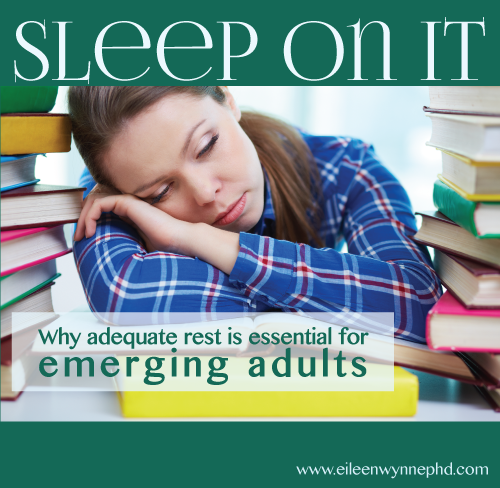
Sleep on It: Why adequate rest is essential for emerging adults

sleep-on-it.png


Sleep is Critical
Throughout your life the amount of sleep you require changes, as do many other aspects of your physical and psychological landscape. One thing that remains constant is the fact that you need to get enough sleep. Enough sleep for college students and young adults is about 8 hours per night. The National Institute of Health notes that college students are one of the most sleep deprived segments of the population. This data matters because sleep deprivation has a negative effect on memory, concentration, and students’ ability to learn.  This problem affects a major portion of the population, as 70% of Americans deal with the negative impacts of chronic sleep loss and other sleep disorders and most college students report sleep deprivation and insufficient and irregular sleep, both leading to daytime sleepiness. The results are lower GPAs, academic failures, increased auto accidents, and impaired mood.


Essential for a healthy body and mind, quality sleep is particularly important to college students because it helps reduce stress, helps you to make better judgements, improves mood, increases energy, and supports your ability to learn and retain new information. While you are asleep, your brain builds new pathways that better enable you to learn and contribute to improved memory and the increased ability to have new insights. Additionally, while you sleep, your heart rate slows down giving your over-stressed system time to relax.


sleep-stats2.pngsleep-stats-1.png
Getting Enough
Now that we have established that getting enough sleep is essential to feeling good and functioning well, I am adding some tips for getting more sleep that may help you get more rest.


  • Avoid consuming caffeine after about 4pm.
  • Avoid consuming alcohol 4-6 hours prior to bedtime as it can seriously disrupt your sleep.
  • Turn off computers, tablets, and other technology at least 30 minutes before you intend to sleep. The light from such devices can make our brains think it is daytime, in turn making them less likely to shut down.
  • Do something relaxing before bed. Read a book or have a bath.
  • Exercise! Physical activity improves the likelihood that you will fall asleep and get quality rest.
  • Spend time outdoors. Natural light can help your body stay in touch with natural sleep-wake cycles.
  • Try to develop a schedule for your school work so that you don’t have to pull all-nighters. These are bad for overall health and concentration. Good time management can have a positive impact on every aspect of your university experience.
  • Sleep at night and avoid naps. This will help you stay in touch with your body’s natural rhythm. (Sleeping at the wrong time can contribute to getting out of touch with the body’s natural rhythm.


As always, I hope this information is helpful! Enough sleep can improve the quality of many different aspects of life. College is an exciting time full of rich new experiences. Daytime drowsiness can decrease the ability to fully embrace all that this time has to offer.

Sincerely,
Dr. Eileen Wynne


References: