Showing posts with label Millennials. Show all posts

Thursday, January 18, 2018

Get Connected: Real-World Relationships in the Digital Age


For all of the convenience of the modern world, from GPS systems to smartphones, interpersonal relationships seem to be getting more difficult to negotiate in the digital age. It may seem counter intuitive that in a time where we are more connected to those in our social networks more often than at any other point in history, so many people feel lonely and detached from one another.   

In this post, I will look at some of the factors causing people to feel a sense of depression and disconnectedness in this hyper-connected culture, as well as some simple ways to mitigate the issues that arise as a result of the overwhelming technology-focus in modern relationships.

The Link Between Social Media and Depressed Mood

This is a topic that comes up often. Several factors may contribute to the negative emotional consequences and even depression that correspond with social media use.  An obvious cause of depressed mood resulting from social media use is bullying or other negative online experiences. It is estimated that about 50% of adolescents have been bullied online and about 80% report having had negative experiences.  Research conducted by the University of Pittsburgh School of Medicine found a correlation between time spent using social media and depression. Another well-researched cause of negative mood is the tendency of people to compare their lives to the highly curated lives of friends and acquaintances. The resulting jealousy and sense of inadequacy can cause a great deal of suffering. This can translate into bitterness and emotional aggression towards people in real life resulting from online interactions. 

The Communication Gap with Texting and Instant Messaging
Ever found that what you were trying to text to someone was completely lost in translation? If you are like me, you have had conversations in which both parties later pulled out phones and compared in an attempt to clarify some mistyped or poorly punctuated statement that caused a disagreement or mishap of some kind.  Texting can be a wonderful way of quickly communicating, but it can also be problematic when you attempt to translate more complex communication with its limited functionality.   

Virtual Spaces
Social media makes us feel as if we are participants in the lives of loved ones and old friends as we watch their children's birthday parties and vicariously enjoy images of weddings and new homes, but this digital participation lacks the emotional impact of non-virtual interaction. In a real-life friendship, there are conversations and disagreements. It is through that type of dialog that young people are socialized and adults maintain critical skills like emotional intelligence and empathy. It is through real-world interactions that our society stays intact as people learn to navigate challenge and conflict and come to a consensus with others. While it is wonderful to stay aware of the lives of those we love through social media, without true contact, we are merely consumers of their life experiences.

Other concerning issues have arisen as a result of the heavy of social media use currently being observed in culture, such as the inability of many digital natives (generations raised with access to digital technology) to interact in a non-digital environment. In addition, there has been a lot of research on the way screen time, the predominance of structured (adult-supervised activities over child-driven activities), and digital communication are degrading conflict resolution skills in emerging generations.

Friendship in the real world.
After all the talk about the negative impacts of modern technology and social media, you may be wondering about positive use. It is important to remember that these communication platforms exist because they give us the ability to quickly and easily share a memory with a former college roommate that we have not seen in awhile, or reach out to family members across the country while planning a reunion. These platforms did not rise to unprecedented levels of popularity they now boast by being the cause of depression and negativity. We use social media to stay connected. It can be an asset to our lives if used properly.

How can you have more genuine friendships while still enjoying the convenience of digital life? Social media platforms, like smartphones and televisions, are a communication tool. There is nothing inherently wrong with using social media. Still, it's important to remember that communication is best when it goes both ways. To make social an ally to your relationships, rather than a hindrance, I have a few suggestions:

Think about what you really want to get out of your social media use
Lots of people get on social media to kill time but never really take the time to think about why they chose to spend part of each day using it. I suggest taking a little time to think about the ways social benefits you and the ways it may be detrimental and create an action plan for yourself. If you waste time using Pinterest on your phone while you should be doing something productive, consider removing the app and using only when you are sitting at your computer. If looking at celebrity gossip makes you feel bad, make a deal with yourself to stop clicking. Be aware of the pleasures and pitfalls and let that awareness govern your choices.  

Have conversations with people rather than just existing as an observer
This is key to positive social media use. When you are feeling a little too much like an online stalker or voyeur – take the time to instant message an old friend or send that thank you email to your aunt.  It is vitally important to have healthy real-world relationships with people you love and trust. These form the basis for your understanding the world and are the primary areas in which you practice conflict resolution and connectedness. Interacting online with people you have consistent non-virtual contact with can be a great deal of fun!

Set limits
Limit the amount of time you spend on social media each day. Set limits on the number of social media platforms you participate on (research has shown that the more social networks people are involved in, the bluer they feel). Set limits on who you interact with (if someone habitually makes you angry, stop looking). This may sound a bit extreme, but restrictions can be really healthy when it comes to social media use. I have clients who have chosen to remove all social apps from their phones or look exclusively at content that improves their lives. This type of thoughtful consumption can go a long way toward making social a positive factor in your life.

New technology definitely impacts the way we relate to one another in this day and age. Being more aware of the way digital interactions make you feel can help you have healthier relationships, online and off.


Struggling to find balance and navigate relationships in the digital world? I am available to help! Formerly on staff at the Tulane Student & Health Center of Psychiatry, helping emerging adults uncover the best path to success is my passion, I am a professional psychotherapist and I specialize in academic, success, and life coaching. I work primarily with college students and young professionals. I would love to put my expertise as a certified success coach to work for you.

Sincerely, 
Dr. Eileen Wynne

Let's connect!

Tuesday, July 18, 2017


Millennials and the Potential for Self-Actualization

The idea that reaching one's fullest potential is something worth striving for doesn't get enough attention in our hyper-distracted modern landscape. Many of us are preoccupied with shorter-term, more easily gratified pursuits, but the long game of personal grown is definitely one worth striving for. Millennials, though beset by the economy and the drastic changes in society over the last decades, may be the generation best positioned to successfully undertake this lofty goal and in fact, may be doing so by taking a short-cut. Let me explain why I say this, and what I see as the biggest challenge to their face to self-mastery and how I think they are working around it. 

Millennial Values

My experience with Millennials and all the literature I've read seem to say the same thing; as a group, these young folks are remarkably optimistic and aspirational. The Pew Research Center describes millennials as "confident, self-expressive, liberal, upbeat and open to change." They have a strong sense of justice and are more concerned with the way the work they do makes them feel and the impact it has in the world than they are with working solely to gain material wealth and trappings. They are extremely agile — they have not come up in an environment where things have been stable and therefore, are comfortable with change in a way that even Gen Xers are not.  Many of the traditional career paths that previous generations counted on are are not available to this generation, which has made them creative and resourceful. In short, Millennials are resilient. 

The Path to Self-Actualization

Abraham Maslow was arguably one of the most important psychologists of the 20th century. He is most famous for developing the hierarchy of needs, which is essentially an overview of typical human development. This hierarchy can be visualized as a pyramid. At the base are the most basic physiological needs which include the need for nourishment (food and water), sleep, and warmth. These needs are foundational and are the strongest because if they aren't met an individual will not survive.  Next, comes another fairly basic the need: safety. Safety and security go hand-in-hand and meeting this need can consist of having a home and income, as well as freedom from potential dangers such as crime and political unrest.  After safety comes the more complex social needs of love and belonging, primarily from relationships with family, friends and intimate partners.

The need for esteem is a higher-level psychological need that articulates the human hope of being respected and recognized for accomplishments. The need for esteem includes the desire to feel satisfied with one's self and valued by others. This need is often met in the workplace, or in a team situation and if it is not met, according to the hierarchy of needs, the final need can't be met. The final and most complex is the need for self-actualization. This is a self-fulfillment need that encompasses all the activities, intellectual and creative, that are required for an individual to achieve their full potential. 

What characterizes a self-actualized individual? They accept others and also themselves, they have high emotional intelligence, and feel comfortable with change and uncertainty.  People who have attained self-actualization are independent and autonomous. They feel comfortable alone, particularly because gratification comes from within rather than from external sources. These people experience present moment awareness and are therefore objective about personal achievement and misfortune. Most importantly, they have a growth mindset and are willing to try new things that will enable personal growth, even when these things are difficult or uncomfortable. 


Roadblocks to Self-Mastery

One problem that many millennials face is the difficulty in achieving the highest level needs in Maslow's pyramid. According to the pyramid, esteem must be achieved ahead of self-actualization, and with the absence of linear careers, that enable easily discernible growth through promotions, raises, etc.,  it is more difficult to move through this level in a clear manner. Although they are highly educated, when school is finished many fail to find a next step to allow for the kind of career progress that previous generations enjoyed. In fact, they face the higher rates of unemployment than any workforce in three decades. 

Additionally, many millennials are making choices that seem radical to older generations, not marrying, choosing to be childless, deciding not to own properly or vehicles. In many cases, their global and urban lifestyles make those things feel like hindrances rather than values. Recent research by the Brookings Institution showed that over 87% of millennials disagree with the statement that “money is the best measure of success” and most would prefer to work for a company they feel is ethical or allows them to do work they find meaningful than make a lot of money. With a focus on being rather than on achieving, many millennials seem stuck in the lower rungs of Maslow's pyramid with no way of moving into higher levels. This generation is also much more oriented towards belonging and being aligned with the values of peers than being competitive, they are more cooperative than competitive. They require recognition, which can be evidenced by recent Pew Research Center statistics that one in five of them have posted a YouTube video of themselves while three-quarters have social profiles. Social media helps fill a need for belonging. In short, millennials are blocked in many ways from achieving esteem through typical channels, while simultaneously finding great value in belonging. They seem to be caught up in some of the lower rung values with no clear path to achieving the highest level needs. 


A Shift in Thinking 

In the traditional pattern followed by Maslow's hierarchy, fulfillment of needs comes in a  specific order. Is it possible that for twenty-somethings, aspects of belonging, esteem, and self-actualization happen simultaneously? When I look at the characteristics of a self-actualized person, such as present moment awareness, the willingness to try new things, and comfort with uncertainty, I see consistency with the key values and behaviors of this generation. In some ways, the circumstances in which this group has come of age may have caused them to skip a step and achieve some of the characteristics of self-actualization while still at the belonging or esteem levels of development. They have completely different values than previous generations, and maybe that's a good thing. Perhaps the advanced development in some areas accompanied by the setbacks in others has given them a unique perspective that time will teach us to respect and appreciate. 

The largest generation in Western history may just transform the way we understand everything by creating a system that is more value based than transactional, and remind us that rules were made to be re-imagined. They may teach us that experiences really are better than things and that systems we thought were solid, still need adjustment. It's too early to say, but this generation certainly does keep me on my toes!

Monday, June 20, 2016

Making Their Way: Unique challenges of being a Millennial


When you see the numbers, you may wonder what is happening with Generation Y.

•    Millennials make up about a quarter of the U.S. population
•    37% of millennials are unemployed
•    Approximately 1/3 of millennials still live with parents
•    In 2013, only 30 % of young people (ages 20-34) were married, (compared to 77%  in 1960)

Accusations of perpetual childhood and Peter Pan syndrome in millennial culture abound, but are choices like is staying at home with parents and not getting married really choices, or has culture shifted so much that young people don’t know how to navigate it and make their way into adulthood? Author Jeffrey Arnett describes the extended adolescence of what he calls “emerging adults” and suggests that young folks today may have more time and space to develop into good humans with strong foundations as a result of this extension of childhood. Additionally, many suggest that time for exploration before settling down and getting married may lead to more stable relationships, not less. These optimistic takes are far fewer than the criticisms of Gen Y. Many recent articles on the subject complain about inflated self-opinions which are the natural result of a culture of political correctness where everyone wins, with or without merit;  and the whole generation’s constant desire for praise and reward without commensurate skill. They also note the self-obsession that is the natural result of social media and reality TV culture. The one thing no one argues about is the fact that millennials are definitely behaving differently than previous generations.

What a difference
A recent study conducted by the Pew Research Center looked at millennial behavior and demonstrated that for the first time in over a century, young people (ages 18-34) are living with parents more frequently than in any other type of living arrangement.  With a third (32.1%) of young folks remaining in their parents’ homes, rather than living alone, with a romantic partner, with a friend or non-parent family member, or in a college dorm; it is natural to wonder what has led to the shift. Some researchers attribute these new trends to the fact that fewer young people are settling down romantically. It is noted that young men are more likely than young women to be living in the home of a family member while women are more likely to be the head of a household because they tend more frequently to be single parents.

The study suggested that a few different factors contributed to the change, namely (and not surprisingly); marital status, education, and employment. Researchers  place most weight on the fact that many young people in the U.S. are making the choice not to settle down with a romantic partner and this postponement, and sometimes complete retreat from marriage, removes some of the impetus to leave the nest. In fact, in the last decade, the median age for first marriage has steadily increased, with one in four never marrying at all, leaving many wondering if there is something wrong with the entire generation. We fail to ask, time and time again, why don’t these young people want to settle down? What is the root cause of the decline in independent living and failure to marry?

Products of a rotten economy?
Fox News’ Dr. Keith Ablow is quick to attributes these trends to a weak economy and overall lack of employment opportunities for millennials. He also makes  some rather harsh criticisms. It is an absolute fact that employment trends have contributed to the changes in millennial lifestyles and to blame it completely on marriage is to miss a big piece of the puzzle. The Great Recession stopped many young people in their tracks, making things harder than they have been for previous generations and instilling many with the fear that there was no place in the working world for them. While some have been discouraged to the point of depression, this has served to make many young people resourceful and nimble.  Ablow describes dispirited youth with squandered potential,  depressed, anxious, and high on legal drugs, seeking desperately to get free from the tyranny of continually coddling parents. He goes on tirades about Tinder culture, and young folks hooking up rather than having meaningful, long-term relationships. Fortunately, the reality is a more complicated and interesting than that. Millennials are making different choices, but they are, in fact, making choices.

Setbacks lead to a new worldview
The findings of the Pew study may seem discouraging to many older Americans who can’t understand why so many young folks are falling behind.  The conversation typically circles around to larger cultural criticisms; talk of an entire generation ruined by too many frivolous participation awards and pointless kindergarten graduation ceremonies, and genuine achievement being watered down by a culture by handing out a steady stream of awards and accolades for next-to-nothing. There are also the inevitable complaints about laziness, video games, and substance use.  Still, it’s important to note that this generation has also faced instability and change, significantly different from that of previous generations. As with nearly every issue facing us today, there are multiple contributing factors – the Great Recession being a big one and the cultural shift that taught young people that every tiny achievement was worthy of accolades is another.  At the core of the litany of complaints from other generations is that this group can’t seem to let go of childhood. Maybe that is true. But in some ways, not jumping into things one isn’t ready for may be a maturity older generations never go the luxury of exploring. The truth is that there is no conclusion to this conversation. This generation of emerging adults if figuring it out as they go, just like every other generation before has had to do.

From a paper about Millennials published for the White House by the Council of Economic Advisors in October 2014

“…while there are substantial challenges to meet, no generation has been better equipped to overcome them than Millennials. They are skilled with technology, determined, diverse, and more educated than any previous generation. Millennials are still in the early stages of joining and participating in the labor market. Taking steps to help them access and complete college, manage their student debt, have better opportunities for training and connection to jobs, access the credit they need for a home, protect the network neutrality that is the basis for much of their technological activity, as well as general policies to strengthen investment, job creation and wage growth, all have the potential to have a lasting impact for this generation and thus for U.S. economic performance for decades to come.”

Please feel free to reach out to me if you’d like to further discuss the unique challenges facing Millennials. I am a Psychotherapist available to young professionals and emerging adults who are ready to overcome their challenges and transform their lives!  My website it full of blog entries and useful content to help you along your way, and I hope you find this free content useful on your journey. Feel free to reach out to me directly if have any questions or if you are interested in scheduling a private session.

Sincerely, 
Dr. Eileen Wynne


References

Thursday, April 28, 2016

Neverland: The alarming new trend with Millennial men

Recently there have been several articles in prominent publications and television news pieces about the alarming trend of young men failing to launch into adulthood.  Many of the articles look at this disturbing trend from the angle that positions young women as more ambitious and better educated than their male counterparts making the story seem like a positive one. In reality, even though celebrating the achievements of young women is wonderful and vitally important to our society, the fact that it seems to be happening at the expense of young men, or in contrast to the dramatic decrease in motivation of males, is a very real problem with potentially far-reaching consequences. Women are not getting ahead strictly on the basis of increased effort, though they are definitely working hard. There is another factor at play that we could not have predicted.

According to a recent article in the UK’s Daily Mail, new research shows that The U.S. “is producing a generation of 'lost boys' who lack the drive to start their careers and instead drop out of college and end up languishing in their parents' basements surfing the internet.” This assessment may seem harsh, but the data backs it up. Women are earning a larger percentage of degrees than their male counterparts. In addition, between 1970-2007 women’s salaries have increased by 44%, while men have only seen a 6% increase. While this increase may point to the equalizing of the pay gap in society, it may also be a component in the lack of motivation we are seeing in young men. The unemployment rate for young men has also increased. From about 5% in 1950 to what we are currently experiencing, the highest recorded rate of  20%.


% Degrees Earned by Gender


Implications for greater society

An article posted by CNN linked this new set of behaviors, lack of motivation, and failure to mature to larger issues; to things like men being more distant from family and out-of-wedlock birthrates.  The educational gender gap also means that there are more females in college than males, and they have been called the new economic underclass as many young men may fall behind losing prospects for partnership. In fact, we are already seeing and an increasing number of young couples are delaying marriage or foregoing it altogether. Studies have shown that men between the ages of 18-34 spend more of their time playing video games than those who are 12-17. Many young men stay at home, living with parents longer and have lower employment than female counterparts. The very real problem of a generation unprepared for the challenges of managing adult life and participating in larger society.

What is behind this alarming trend?

Numerous factors have been pointed to as the causes of this trend:
  • The job market: fewer promising prospects for the future
  • Addictions: the availability of various substances as well as that of internet and video games
  • Apathy and lack of passion: many young men report experiencing feelings of hopeless and disillusionment starting in high school
  • Films and television shows that glamorize underachieving, immature men and applaud the stereotype
  • Changing gender roles which lead to confusion about what role young men should play in society and relationships


Unfortunately, no one has yet been able to pinpoint the true origin of the problem. To date, we have mostly noted the symptoms and begun to study the trends more closely. What we do know is that in the current culture, many young men are failing to set and achieve goals.  They are not meeting  responsibilities or achieving on par with their potential. And what we also know is that we don’t know quite how to address the issue.  

Shifting ideas of adulthood
It may well be that what we are witnessing is a generation developing new definitions of success and adulthood. New ways of approaching politics, career, consumerism, and relationships are emerging with the Millennials. There have been innumerable articles written about how Millennials value doing good over making lots of money and how they tend to want to rent rather than buy a home. There are many values held by this emerging generation that differ strongly from the ones that came before. It is possible that this new trend is part of the transition to a new way of relating to life and society.

Sincerely,
Dr. Eileen Wynne

References

Monday, June 22, 2015

Sleep on It: Why adequate rest is essential for emerging adults

sleep-on-it.png


Sleep is Critical
Throughout your life the amount of sleep you require changes, as do many other aspects of your physical and psychological landscape. One thing that remains constant is the fact that you need to get enough sleep. Enough sleep for college students and young adults is about 8 hours per night. The National Institute of Health notes that college students are one of the most sleep deprived segments of the population. This data matters because sleep deprivation has a negative effect on memory, concentration, and students’ ability to learn.  This problem affects a major portion of the population, as 70% of Americans deal with the negative impacts of chronic sleep loss and other sleep disorders and most college students report sleep deprivation and insufficient and irregular sleep, both leading to daytime sleepiness. The results are lower GPAs, academic failures, increased auto accidents, and impaired mood.


Essential for a healthy body and mind, quality sleep is particularly important to college students because it helps reduce stress, helps you to make better judgements, improves mood, increases energy, and supports your ability to learn and retain new information. While you are asleep, your brain builds new pathways that better enable you to learn and contribute to improved memory and the increased ability to have new insights. Additionally, while you sleep, your heart rate slows down giving your over-stressed system time to relax.


sleep-stats2.pngsleep-stats-1.png
Getting Enough
Now that we have established that getting enough sleep is essential to feeling good and functioning well, I am adding some tips for getting more sleep that may help you get more rest.


  • Avoid consuming caffeine after about 4pm.
  • Avoid consuming alcohol 4-6 hours prior to bedtime as it can seriously disrupt your sleep.
  • Turn off computers, tablets, and other technology at least 30 minutes before you intend to sleep. The light from such devices can make our brains think it is daytime, in turn making them less likely to shut down.
  • Do something relaxing before bed. Read a book or have a bath.
  • Exercise! Physical activity improves the likelihood that you will fall asleep and get quality rest.
  • Spend time outdoors. Natural light can help your body stay in touch with natural sleep-wake cycles.
  • Try to develop a schedule for your school work so that you don’t have to pull all-nighters. These are bad for overall health and concentration. Good time management can have a positive impact on every aspect of your university experience.
  • Sleep at night and avoid naps. This will help you stay in touch with your body’s natural rhythm. (Sleeping at the wrong time can contribute to getting out of touch with the body’s natural rhythm.


As always, I hope this information is helpful! Enough sleep can improve the quality of many different aspects of life. College is an exciting time full of rich new experiences. Daytime drowsiness can decrease the ability to fully embrace all that this time has to offer.

Sincerely,
Dr. Eileen Wynne


References:

Sunday, May 3, 2015

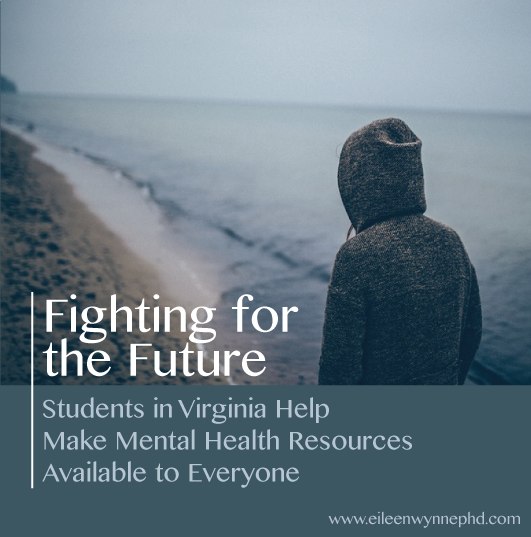
Fighting for the Future: Students in Virginia Help Make Mental Health Resources Available to Everyone

Fighting-for-the-Future.png


As I noted in my previous blog on this subject, over the last decade, there has been a dramatic rise in mental health issues for students nationwide.  With a quarter of 18-24 year olds estimated to have diagnosable mental illnesses, we really do appear to be having a mental health crisis. An increasing number of colleges and universities are taking positive and responsible action to ensure the safety and well-being of students by setting up mental health centers and providing students with information about additional mental health resources. Still, the relatively limited reach of a university mental health center may not be enough for some students, particularly if they don’t even know the center exists. 

Coping with mental health problems can be extra challenging for emerging adults. Furthermore, dealing with things like anxiety and depression can be downright debilitating without the proper resources. To date, even at colleges and universities where there is a dedicated staff of counselors and psychologists available to offer services through student health centers, the  lingering stigma attached to mental health and the fact that students remain unaware that these resources exist, prevent many students from getting the help they need.

With all of this seemingly negative news on the subject, it is refreshing and inspiring to know that a group of students at UVa (University of Virginia), called the Young Legislators of Tomorrow, brought this issue to the attention of lawmakers in their state. The group introduced a Bill (House BIll 206) requiring universities to provide more and better information about mental health resources to students. 

In 2014, this legislation passed in the House 99-0, making it a huge win for those determined young people trying to raise awareness and make the world a better place for the students coming after them. It is also a victory for all the future students who will be better able to find the help they need as a result. 

According to Virginia’s Legislative Information System, the summary of the bill is as follows: Four-year public institutions of higher education; mental health resources. Requires each four-year public institution of higher education in the Commonwealth to create and feature on its website a page with information dedicated solely to the mental health resources available to students at the institution. (The bill has a delayed effective date of July 1, 2015.)

The combination of the stigma attached to mental health problems and students’ lack of familiarity with the resources available to them has allowed many to suffer needlessly. Thanks to this group of students, the awareness part of that problem is going to be significantly minimized in the future.


Sincerely,
Dr. Eileen Wynne


References: