
Showing posts with label life transitions. Show all posts

Monday, May 18, 2015

Going Places: Finding Your Life's Work


Going-places.png


Whether you are 23 or 43, figuring out what you want to do with your life can present a serious challenge. According to Abraham Maslow’s oft cited Hierarchy of Needs, self actualization rests at the top of the five stage pyramid and is the last of the humans needs to be achieved as one moves through life. It makes sense that more basic needs like psychological and safety requirements must be met before higher level needs like esteem and self actualization can be accomplished. Typically, a satisfying career fits into the higher stages of a system like this. It is not essential to survival, but it is key to high functioning and emotional growth that one finds work that is challenging and fulfilling.

Discovering Aptitude
There are myriad personality and career aptitude tests designed to help you figure out your ideal career. These tests can help you assess where your interests, values, strengths, and preferences converge. Some of the most common are:
  • Myers-Briggs Type Indicator (MBTI)
  • Strong Interest Inventory (SII)
  • Self-Directed Search (SDI)
  • Career Ability Placement Survey (CAPS)

These will profile you make suggestions that may help you find a suitable path.

Figuring out what you are meant to do
After analyzing your aptitudes, you will be left with your intuition and inclination. What you are really meant to do may take some time and work to uncover. Finding your path is a process that takes many factors into consideration. The intersection between what you are great at, what you love to do, and what you can make money doing may help you realize what you are truly meant to do.
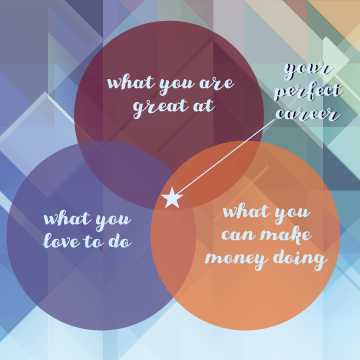
Venn.png

There are numerous books and workbooks on this subject, but, a few simple questions that may point you in the right direction and help you figure out what your life’s work should be are:

What have you always loved to do?
What have you loved doing since you were a kid? What hobby do you do that is so wonderful that you lose time entirely while participating in it? This activity may be a hint at what you are meant to do in life. Think about careers that incorporate your beloved activity in some way.

What are you attracted to?
What is your favorite movie? What music do you love? What are your favorite museums? What countries fascinate you? Your cultural interests may help you find your perfect career path.

What are you really great at?
Sometimes the thing that comes most naturally to you is what you are meant to do. Be it bicycling or painting watercolors, the things that you naturally excel at may hint at what you are meant to do with your life.

When you follow the things that inspire and excite you, you will be well on your way to finding a fulfilling career. When you find the job you were meant to have, you will still have to work hard, but it will not feel like work because you’ll derive incomparable satisfaction from it. Whatever your path, remember that everyone has a very unique part to play. There is something that you are here to do that no one else can do quite as well as you can. When you find that thing, you’ll feel harmonious and expansive and your life will open up with great opportunities.


References

Sunday, June 22, 2014

See yourself through someone else's eyes


Confiding her fears and doubts about her new internship wasn’t easy for my young friend Sarah. Because she feels like an impostor, she has a strong compulsion to hide her fears. After all, confident people who know what they’re doing aren’t afraid of anything, right? Admitting her insecurities would tip everyone off to her fraud.

Of course we know that’s not true. Self-assured, competent people are plagued by the same fears and doubts as everyone else; they just don’t allow those fears and doubts to halt their growth. They accept mistakes as a part of their development, welcoming errors as an opportunity to begin again more intelligently, as Henry Ford once said.

Confessing her fears was Sarah’s first step towards overcoming the limitations imposed by what psychologists refer to as impostor phenomenon. She bravely faced her fear of judgment and made room for the possibility that maybe what she was feeling could be simultaneously normal and irrational. Normal in the sense that an estimated 70% of the population experience impostorism at least once in their lives; irrational in the sense that her reasoning skills, her ability to accurately judge her own value, has been overcome by baseless self-doubt.

I have a strong suspicion that Sarah was awaiting confirmation that the advertising firm had goofed in their records of interviewees. However, by getting her fears out in the open, she was able to face the fact that maybe she was misjudging her future employers’ competence. After all, they didn’t become successful by haphazard hiring practices. 

It’s old hat now to say that the first step towards solving a problem is admitting you have one, but there’s a reason we’ve clung to the saying. It’s true. By sharing her fears, Sarah was able to begin playing with the possibility that they are unfounded, that the problem that she needs to overcome isn’t a lack of intellect or skill, but a burden of self-doubt, that the only person she’s fooling is herself.

That’s the problem with impostorism. The fact is, you got where you are because of your talents and your skills, your efforts and your perseverance. But impostorism feeds you a line about luck and lies. 

Your GPA isn’t a product of a professor’s generosity. Maybe we should give up that old idiom, “My teacher gave me an A.” In fact, in nearly every case that a student receives a high score on a test, it is the totally predictable result of the student learning the material. 

Your boss didn’t hire you based on false pretenses. You earned a degree. You gained experiences. You built a portfolio. 

You did that. You should be proud. While it’s a necessary part of growth to acknowledge your mistakes and weaknesses, it’s equally important to acknowledge your victories and accomplishments. 

If you’re feeling like a fraud, like you just lucked up when you got that promotion or passed that test, try sharing your fears with someone whose opinion you value. Don’t keep it to yourself. Let others help you see yourself the way that they do. It’s not a cure for the impostor blues, but it’s a step in the right direction.

Eileen Wynne, PhD.

References:

Alexander, J., & Sakulku, J. (2011). The Impostor Phenomenon. International Journal of Behavioral Science, 6, 73-92.

Cokley, K., McClain, S., Enciso, A. and Martinez, M. (2013), An Examination of the Impact of Minority Status Stress and Impostor Feelings on the Mental Health of Diverse Ethnic Minority College Students. Jnl Multicult Counseling & Dev, 41: 82–95. doi: 10.1002/j.2161-1912.2013.00029.x

Weir, K. (2013). Feel like a fraud? GradPsych, 11, 24-27.

Sunday, June 15, 2014

The impostor's lament

Are high achievers only
fooling themselves?
“I don’t deserve to be here,” Sarah said, fidgeting with the corner of her blouse. 

A talented student with numerous academic accolades under her belt, Sarah had recently interviewed with a successful advertising firm. Though she still had two more classes to complete, the firm was eager to take her on as a paid intern to prepare her for a job upon her graduation the following semester. 

You might expect that Sarah would be brimming over with joy at the prospect, but instead, she felt that she had somehow conned the firm into offering her the position. This, in turn, caused her to doubt her ability to perform the responsibilities that came with her new role. Rather than experiencing the pride of accomplishment, Sarah was experiencing anxiety.

More specifically, she was feeling the pain of a very common phenomenon known as impostor syndrome. Though impostor syndrome isn’t listed in the Diagnostic and Statistical Manual of Mental Disorders as an official diagnosis, its effects are felt by most people at some point in their lives. 

Think about a time when you experienced success. Now consider the following thoughts. 
  • I just got lucky.
  • I don’t belong here.
  • Once they realize I don’t know what I’m doing, they’ll get rid of me.
  • I’m not as smart/talented/skilled as they think I am.
  • It won’t be long before they figure out I’m a fraud.
Do any look familiar to you? If so, you’ve felt the painful doubts created by the impostor phenomenon.

The irony of impostor syndrome is that high achievers tend to be the most susceptible to it. I see it often in students who have worked diligently, spending hours in studious labor, and in adults who have excelled at their chosen profession through hard work and high expectations. As we transition into new careers or life experiences, we're particularly vulnerable to these feelings of not belonging, of fraudulence. 

While research has shown women and minorities top the charts for these feelings of “passing themselves off” rather than authentically achieving, the phenomenon can be said to be a natural by-product of a society that puts perhaps too much pressure on its individuals to succeed at all costs. 

In schools and homes, we stress to our children the need to achieve, and it may be that the message is received and processed in ways that we don’t anticipate. It may be that we’re sending our children the message that the love, attention, and respect that they crave must be won through constant showmanship. What a heart-breaking idea.

During the next few weeks, I’d like to talk with you about overcoming some of the habits and mindsets that lead to this sense of being an impostor because I suspect that both you and Sarah have something to offer the world that is not only good enough but is much needed.

Dr. Eileen Wynne

References:

Alexander, J., & Sakulku, J. (2011). The Impostor Phenomenon. International Journal of Behavioral Science, 6, 73-92.

Cokley, K., McClain, S., Enciso, A. and Martinez, M. (2013), An Examination of the Impact of Minority Status Stress and Impostor Feelings on the Mental Health of Diverse Ethnic Minority College Students. Jnl Multicult Counseling & Dev, 41: 82–95. doi: 10.1002/j.2161-1912.2013.00029.x

Sunday, June 1, 2014

Why 30 doesn't have to be a deadline

Does the approach of 30 mean that opportunity is slipping away?
Certainly not. 
If you’re feeling the pressure of the 30 year deadline, you’re not alone. That looming date has long marked the whittling away of life’s options. Certainly in times past, this anxiety was justified. In 1900, the life expectancy of the average American was 48, making 30 a ripe old age. 

But let’s put things into perspective. Today’s average life expectancy is nearly double what it was at the turn of the last century. Maybe it’s time to consider pushing the timetable back a little bit to give emerging adults an opportunity to savor this long and winding life. 

It’s true that in 1960, 77 percent of American women and 65 percent of American men had reached the five milestones of adulthood marked by sociologists - completing school, leaving home, becoming financially independent, marrying and having a child. However, a lot has changed in the United States since then. We know much more than we did.

For one thing, we’ve learned a lot about the way that human brains develop as we age. Once upon a time, we were fairly certain that brains “aged out” in our teen years, but tests by neurologists in the 1990s showed that wasn’t the case. On the contrary, they indicated that the brain continues to change, refining its processes, becoming better and better at what it does, for much longer than we originally thought. The prefrontal part of the brain - that part of the brain that lets you consider your own thoughts, make decisions, and set goals - is still evolving in the mid-twenties, which might explain why you’re feeling ambivalent about your future if the big 3-0 is on your horizon. 

Albert Einstein once said, “A person who has not made his great contribution to science before the age of 30 will never do so.” There’s no doubt about Einstein’s genius, but even he made mistakes. The average age of Nobel Laureates today is between 45 and 60, and the most inspired work of physicists happens in their forties. 

What does this all mean for you? It means you have time. Your life expectancy is luxuriously long compared to your ancestors. You marvelous brain is still still evolving, stretching to reach its potential. The rush towards adulthood can become a more meaningful journey. The pressures to marry, choose a lifelong career, bear children, accomplish greatness - they can all wait a little longer for you.

If you're an emerging adult feeling the pressure of decisions that lie before you, it may be that you would benefit from counsel. As a therapist and life coach, I am available to listen and to offer an objective perspective as well as much needed support. Let's talk one-on-one about how my coaching and therapy practice can serve you. I can be reached at my Uptown New Orleans office at 504-481-8997.

Dr. Eileen Wynne, PhD

Sunday, May 25, 2014

Emerging adulthood: Time for decisions and revisions.

Do I dare disturb the universe?
And indeed there will be time
To wonder, “Do I dare?” and, “Do I dare?”
Do I dare
Disturb the universe?
In a minute there is time
For decisions and revisions which a minute will reverse.

From The Love Song of J. Alfred Prufrock by T.S. Eliot


In past years, graduation has been a time of excitement and possibility. More often now, I listen to my patients express worry and fear as the big day draws closer.

What is it that has led to this ambivalence about the next phase of life? Why are my young patients so overwhelmed by doubts when they might instead be overwhelming their friends and family with adventurous hopes and plans?

Clark University psychology professor Jeffrey Jensen Arnett has coined the term emerging adulthood to describe what would appear to be a new phenomenon in human development. Emerging adulthood describes the period in a person’s life between the ages of 18 and the late twenties when the child is first emerging from a still protected status into an independent way of life.

But wait, you may say. What’s so different about modern young people that they get a whole new phase of life? Haven’t all humans, then, experienced the same phase throughout history?

Perhaps in some cases, but modern youth face challenges and opportunities that quite simply did not exist for the majority of the population in human history. Let’s consider a few.

Today, graduating students find themselves thrust into an information-based economy. Fewer jobs exist overall, and those that are most desirable require greater expertise, which means more education. Young people must compete vigorously for unpaid internships or burden themselves with thousands upon thousands of dollars in university debt.

Conversely, they find themselves in an entrepreneurial ecosystem that broadens the field of possibility considerably for any person with reasonable intellect, creativity, and even very limited means. The number of startups has increased dramatically over the past few years - 13% between 1999 and 2012. The information economy has made it possible for young, business savvy entrepreneurs to sell their expertise and their products online with little risk and great potential for reward.

Marriage is occurring much later in life, with three-quarters of young people choosing to live with their romantic partners instead for at least some period of time. Likewise, the rush to have children has subsided as birth control has become more acceptable and women’s career options have increased.

This leaves today’s young people in a quandary between the accepted mores of their parents and grand-parents and a very brave new world with seemingly limitless options.

Which way to go? How to decide among them? Do I dare disturb the universe?

The good news, graduates, is that you don’t have to decide today. Emerging adulthood is a natural by-product of longer human lives with many more opportunities to make decisions and revisions in the years to come. Enjoy your special day today. Do not fear what tomorrow may hold. It holds enough to keep you busy, but no more than you can handle.

If you're a young adult going through a life transition, you may be facing conflicting decisions and emotions. Rather than idle in confusion, worrying and fretting, perhaps you would benefit from counsel. As a therapist and life coach, I am available to listen and to offer an objective perspective as well as much needed support. Let's talk one-on-one about how my coaching and therapy practice can serve you. I can be reached at my Uptown New Orleans office at 504-481-8997.

Dr. Eileen Wynne

Sunday, May 18, 2014

Has a hookup left you feeling like an emotional zombie?

Modern students are confronted with difficult decisions regarding sex.
Students still long for more intimate
connections with others.
Match.com has cornered the market on creating happy marriages via the internet according to their commercials, and technology has certainly enabled people to connect with distant soul mates. However, the advent of social media, consisting of random bytes of information flung into the public sphere without thought to consequences, responsibility, or the emotional impact on others, has also led to more fragile relationships in many cases; students who rely heavily on virtual interactions to sustain them socially, often miss the more valuable aspects of real-world connections. 

Pair this detached approach to relationships with the all too common binge drinking of college age students, and you have a recipe for  risky hook ups. Even among young people, there are disputes about the meaning of the phrase hooking up. While the physical act can run the extremes from kissing to casual sex, negative psychological consequences remain constants. 

Hooking up, especially under a veil of alcohol or drugs, obscures responsibility, causes psychological harm, and devalues the importance of meaningful relationships. Where there is no expectation of future contact or commitment once the deed has been done, there can be no expectation of emotional investment or shared responsibility should unwanted repercussions - pregnancy or STD, for example - arise. For those college age students who engage in sex with casual acquaintances, relinquishing the intimate emotional bonds that come from a committed relationship means coping with unforeseen consequences alone. 

Psychological studies have repeatedly shown links between casual sex and psychological injury. While students may experience confidence and even pride during a casual sexual encounter, feelings of guilt, shame, and low self-esteem commonly creep into the psyche after the events. Though a momentary hookup may alleviate feelings of loneliness momentarily, participants in Kinsey researcher Justin Garcia’s study of casual sex among students reported increased feelings of loneliness after these fleeting interactions. Likewise, participants in the study who experienced no depression prior to a casual sexual encounter, elicited depressive symptoms after.

In her book The End of Sex: How Hookup Culture is Leaving a Generation Unhappy, Sexually Unfulfilled, and Confused About Intimacy, author, lecturer, and professor Donna Freitas suggests that dating may be a thing of the past and that romance, in turn, may have breathed its last. So prevalent has casual sex become that the term "emotional zombies" has been coined to describe individuals who have never experienced authentic romantic relationship, moving instead through mindless, emotionless sexual encounters. Yet, consistently, during my therapy sessions, both males and females say they long for more relatedness.

We thrive on relationships as a species. From birth through death, our troubles are more tolerable, our fears more bearable, and our lives more pleasurable thanks to the comforting arms of our family and friends. Meaningful, authentic connections provide a safe haven for us, and committed romantic bonds can be a source of joy, excitement, and encouragement. To develop these relationships, though, we have to demonstrate respect for ourselves and for others. Don't settle for less. Make your relationships powerful, strong, and healing.

Dr. Eileen Wynne PhD

References:

Bersamin, M., Zamboanga, B. L., Schwartz, S. J., Donnellan, M. B., Hudson, M., Weisskirch, R. S., Kim, S. Y., Agocha, V. B., Whitbourne, S. K., & Caraway, S. J. (2014). One night stands may not be good for your mental health: Casual sex and psychological well-being and distress. Journal of Sex Research, 51, 43-51

Freitas, D. (2013). The End of Sex; How Hookup Culture is Leaving a Generation Unhappy, Sexually Unfulfilled, and Confused About Intimacy. Basic Books: New York.

Garcia, J. R., Reiber, C., Massey, S. G., & Merriwether, A. M. (2012). Sexual hookup culture: A review. Review Of General Psychology, 16(2), 161-176. doi:10.1037/a0027911


Sunday, May 11, 2014

Alcohol and College Students: new consequences for old addictions

 https://www.flickr.comphotosglobal-jet3665467103 (Gymnasium festivities; Copenhagen by Global Jet)
Four out of five students drink alcohol.
‘Drink! Drink! Drink!’ The refrain of a frat party on a modern campus? Certainly. But the same shouts rang out in the 20s and 30s when theater-going scholars embraced William Meyer-Fosters’s play Old Heidleberg, the story of a young German prince experiencing college’s trials and tribulations. When the play was adapted into a popular operetta called The Student Prince in 1954, young college students of the conservative post-World War II era could be heard singing the 'Drinking Song' with its rousing chorus of ‘Drink! Drink! Drink!’ in gatherings across college campuses. 

Some elements of student behavior are neither new nor unique. College students have always experimented with alcohol, and most likely they always will. In the past, one-on-one emotional relationships with others provided a moral compass and sounding board for students faced with such temptations. As I mentioned last week, however, technology and social media today have left many young people in the midst of a growing social chasm wherein their peers are more far flung and less genuinely connected than in the past. 

For those students who long for relationships outside of the virtual world, college is still filled with the same struggles as ever. Perhaps more than any other time in an individual's life, the need to belong, to fit in, to be a part of the crowd is pervasive in college. Even with all of our advances, negative peer pressure is still a powerful influence on students that can delay their growth into individuals confident enough to separate from the pack and begin their own, unique journeys in life. Even with all of our new addictions, alcohol still promises to grease the social wheels for students looking to fit into a peer group. One patient told me, "When I’m drunk I feel like I’m more fun to be with.” 

Alcohol has been around since the Stone Ages, and it’s a safe bet that since that time, young people have been pressuring one another to partake. Today, researchers state that four out of five students drink alcohol and roughly 50% of them binge drink. Not surprisingly then, wild house parties filled with students playing beer pong, taking shots of liquor, and posting drunken pictures on Facebook are not uncommon among college students today. 

In fact, peer norms, activities, and patterns correlate positively with binge drinking, making it a nearly universal aspect of college life. Unfortunately, while peer-induced binge drinking may be an old tradition, new technologies mean that the impact can be more far reaching. When future employers search for a recent graduate online, will they find images of the candidate passing out bowls of soup as part of a local outreach or simply passing out? 

The value of a real life peer group, a circle of friends who will support you and encourage you to make wise decisions, can not be overestimated, and while alcohol may win you friends for an evening, it does so at the cost of your health, your decision-making faculties, and your peace of mind. Attempting to unravel the events of a night of binge drinking should be lesson enough in the powers of alcohol to increase rather than reduce college stress.

Experimentation is a necessary and valuable component of college life. New freedoms have been granted us. New opportunities arise. We make mistakes and learn from them, discarding behaviors that don't enrich our lives. We learn to weigh life more consciously, to risk more wisely, and to take responsibility for our actions. Most importantly, we learn to respect ourselves and the lives and spirits of those around us.

Dr. Eileen Wynne PhD

Sunday, April 27, 2014

Social media and loneliness in college

http://www.flickr.com/photos/uberculture/2561190022/ The emotional health of incoming college students has plummeted in recent years reaching its lowest level in a quarter of a century. Meanwhile, their stress levels have increased drastically due in part to greater financial strains and the foreknowledge of limited career options upon graduation. Technology, which on the one hand provides young people with wide open windows upon the world, has also narrowed students' real time social networks.

The world in which young adults find themselves is increasingly difficult to navigate, and these conditions are unlikely to reverse themselves unless we make concerted efforts to reach those students unable to cope with the emotional demands of college and adult life. 

While research suggests that in moderate doses social media can have a positive impact on youth, broadening students' network of peers, in large quantities, which is more and more the norm, social media can harm authentic social interactions. Time on Facebook can increase users' satisfaction, for instance, as well as increasing envy. According to research done by Julie Ross, director of Tufts’ Counseling and Mental Health Service, “Having a constant focus on what is happening somewhere else effectively removes people from staying connected in the face-to-face interactions they could be having, or are having at the moment, as those interactions get constantly interrupted by electronic signals from the phone or computer.”

In addition, the constant, mindless use of technology interferes with students' success in classes. It's not uncommon today for students to spend time during a lecture texting or browsing the internet. University of Virginia psychology professor Timothy Wilson has conducted a study that demonstrates the effects of unhealthy social media and technology use. The gist of his study is that young people deprived of their phones or computers for relatively short times start to become restless and anxious. Anyone, young or old, who has become attached to their smart phones can relate to this experience.

I've spoken with many young people who feel detached from their surroundings, who describe experiences devoid of interactive, emotional engagement, and who seem oblivious to their own social obligations. The trend towards transitory encounters has made building lasting relationships more challenging for young people, and more than ever, they express feelings of loneliness, confusion, and fear. 

If college life as you are experiencing it leaves you feeling miserable, isolated and afraid, begin to change the activities you engage in. Take frequent breaks from technology and social media and immerse yourself in college sports, cultural activities, and community events. Join clubs and study groups so that you can help others and yourself with your studies. Volunteer. Nourish your spiritual side. Learn to meditate and visualize goals. 

Dare to dream. 

The first steps toward expanding and enriching your life are the ones that take the greatest courage, but they can also provide the greatest rewards. It is amazing how often fulfilling relationships and life accomplishments follow those first positive choices. If you would like someone to help you take the first steps to construct or reconstruct the dreams you have for your life, contact me. A challenge is easier when it is shared. My life coaching services can help you reach your greatest potential. 

Dr. Eileen Wynne 

Come back next week, when we’ll examine the high school to college transition further, with particular focus on common socio-emotional issues and psycho-social development.

Freshman Year: the best of times and the worst of times

Greg Anderson Photography
The transition from high school to college both invigorates and excites teenagers. Yet even happy transitions may cause stress and raise mixed feelings because of their potential to overturn a young person's sense of identity and disrupt the fragile balance of familiarity.

Melissa, an enthusiastic young girl whom I've known for years, couldn't wait to go to college. An intelligent and independent student, she was delighted by the promise of choosing a course of study that interested her and of finally having the freedom to make her own choices.

Though she had dreamed about it for years, one month after starting university she realized that her new life was more demanding than she had anticipated. She was forced to question her preconceptions about college life.

She felt homesick, lonely, and lost. The freedom that she had been longing for quickly became overwhelming. She was confronted with seemingly endless choices, and often, she didn't feel confident in her decision-making skills.

Managing her time was problematic as, in the past, a parent, teacher, or other well-meaning adult had generally made sure she got from her to there on time and turned in work by due dates. College work was also more difficult, and she felt academically inadequate, worrying often about how she was perceived by her professors and classmates.

Melissa had nothing in common with her roommate, and she hadn't built a support network of friends yet. She missed the loving warmth of her family, and she feared that she was losing touch with her high school friends. In short, Melissa felt anxious and depressed.

The first year of college presents young people with an opportunity to stretch their legs and stride the path of adulthood; however, high school students are often overconfident in their ability to manage the changes they encounter during their first years of autonomy. The gamut of trials young adults must go up against is daunting, and because we tend to define ourselves by our surroundings, when those surroundings change, it can be disorienting.

However, with support, these transitional years can be a time for tremendous growth. If you're a freshman struggling to adapt to college life, know that you don’t have to face these struggles by yourself. The guidance of a trusted adult such as a therapist or life coach can help you successfully navigate the stress and strain of transition while allowing you to maintain your independence.

Consider contacting my office in Uptown  New Orleans to learn more about how I can assist you through such a transition.

Dr. Eileen Wynne

References:

Mattanah, Jonathan F., Ayers, Jeath.,  Brand, Bethany., Brooks, Leonie., (1980) A social support intervention to ease the college transition.  Exploring main effects and moderators. Journal of  College Student Development. Volume 51, Number 1. January/February 2010,  pp: 93-108.